CMS Final Rule Implementation Timeline for SNF Finance Teams
Finance teams must track four parallel compliance tracks, not just the rate increase.

CMS-1827-F is a cascade of interlocking provisions that finance teams need to track well beyond a single rate adjustment. It is a cascade of interlocking provisions, each with its own trigger date and its own operational consequence. Treating it as one event rather than a sequence is where most implementation planning goes wrong from the start. The rule was issued July 31, 2025, published in the Federal Register on August 4, 2025 as document 2025-14679, and every provision inside it became effective October 1, 2025. That single effective date is deceptively simple. Behind it sit four distinct regulatory tracks that finance teams have to run in parallel, produced by the same rule: PDPM rate and code-mapping changes, QRP reporting obligations, VBP scoring changes, and a new MDS data element removal. The rule also carries a standalone request for information on regulatory streamlining, with public comments due September 15, 2025, giving any compliance officer a chance to help shape what future rules look like. What follows in this piece works through each of those tracks in the order a finance team would actually encounter them: the money first, then the coding mechanics, then the reporting shifts, then the audit layers stacked on top.
What the net rate increase does not protect against
The number everyone quotes first is a net rate increase built from a market basket update, an upward forecast error adjustment, and a downward multifactor productivity adjustment. Unadjusted federal per diem rates took effect October 1, 2025, and from there each facility's actual rate gets shaped further by its case-mix index and by a wage index tied to its Core-Based Statistical Area. That CBSA adjustment is where the sector-wide headline starts to fracture into facility-specific reality.
But what if the rate increase itself isn't the whole story? The rate increase isn't the whole story. CMS separately estimates that the VBP program will pull a material chunk of aggregate payments back out in FY 2026, a drag that runs directly counter to the headline gain and doesn't show up unless a facility is actually tracking its VBP performance standing. So the "catch" isn't hidden in fine print exactly, it's structural. The rate increase is conditional on compliance across the VBP and QRP tracks covered in the sections ahead, and finance teams that budget off the rate alone are budgeting off half the picture, since the VBP withhold-and-redistribute mechanics and the QRP 2% reduction penalty are direct revenue risks that must be tracked separately. QRP non-compliance triggers a 2% reduction to the Annual Payment Update, a penalty that can wipe out a meaningful portion of the net rate gain at the facility level (per Polaris Group). Facilities in rural Mountain regions are projected to see meaningfully higher average increases than the sector headline, while urban Pacific providers may see increases well below it, and finance teams should model facility-specific impact rather than rely on the sector average (per BerryDunn).
October 1, 2025: the PDPM ICD-10 code mapping changes that directly affect reimbursement classification
That's where the rule moves from macro-level to granular, mattering resident by resident. That's not administrative housekeeping. A facility still coding against the old map risks misclassifying residents, which risks underpayment, and which opens the door to an F641 citation for inaccurate assessments.
Why does the Return to Provider designation matter so much? Because a diagnosis mapped to Return to Provider can't drive the PDPM clinical category assignment as the primary diagnosis anymore, even though it can still sit in the record as a secondary diagnosis. That distinction, primary versus secondary, is what determines which PT, OT, SLP, and NTA payment components actually apply to a given resident's case. Get the mapping wrong and the payment components calculated off it are wrong too, regardless of how accurate the clinical documentation otherwise is. Among the codes that shifted to Return to Provider: eating disorder diagnoses including anorexia nervosa, bulimia nervosa, binge eating disorder, pica, and rumination disorder, along with Type 1 Diabetes Mellitus, Hypoglycemia, and Obesity.
Finance teams need to confirm, not assume, that EHR and billing systems reflect these mappings as of October 1, 2025. An assessment completed after that date using the old map is an inaccurate MDS by definition, and that's an audit finding sitting there waiting to be found. Facilities that got the mapping updates right and kept documentation tight going into FY 2026 have a real opportunity to strengthen their reimbursement position. Facilities that didn't are looking at underpayment, denials, and audit exposure stacking up together. F641 citations (Accuracy of Assessments) are the direct regulatory consequence of coding with outdated maps, a compliance risk that connects billing errors to survey deficiency findings (per research brief).
The QRP MDS removal on October 1, 2025 and its change to data collection going forward
The second October 1 action item reads, at first glance, like good news, and in a narrow sense it is. Less to collect, less to document, less room for a data entry error to slip into an assessment. That much is a genuine simplification.
That offset is easy to miss and easy to get backward when projecting forward.
What the removal does not do is soften the compliance consequences sitting around it. The 2% Annual Payment Update penalty for QRP non-compliance remains fully in force regardless of how much lighter the MDS itself got. CMS also codified a new reconsideration standard alongside this change: SNFs facing extraordinary circumstances (the replacement term for what used to be called "extenuating circumstances") can request an extension to file a reconsideration, but that request has to go in no later than 30 calendar days from the date of written non-compliance notification. And the bar for actually winning a reversal is narrow. Full compliance for the applicable program year is required, where full compliance includes having secured an approved exception or extension, not simply having a good excuse. CMS also continues posting facility-level QRP results on Care Compare, which turns quality performance into a public reputational issue that sits alongside, not instead of, the reimbursement stakes. The removal applies beginning with residents admitted on or after October 1, 2025, and affects the FY 2027 SNF QRP calculation (finance teams should understand the program-year offset when projecting forward).
The VBP program mechanics and the deadlines finance teams must calendar through FY 2029
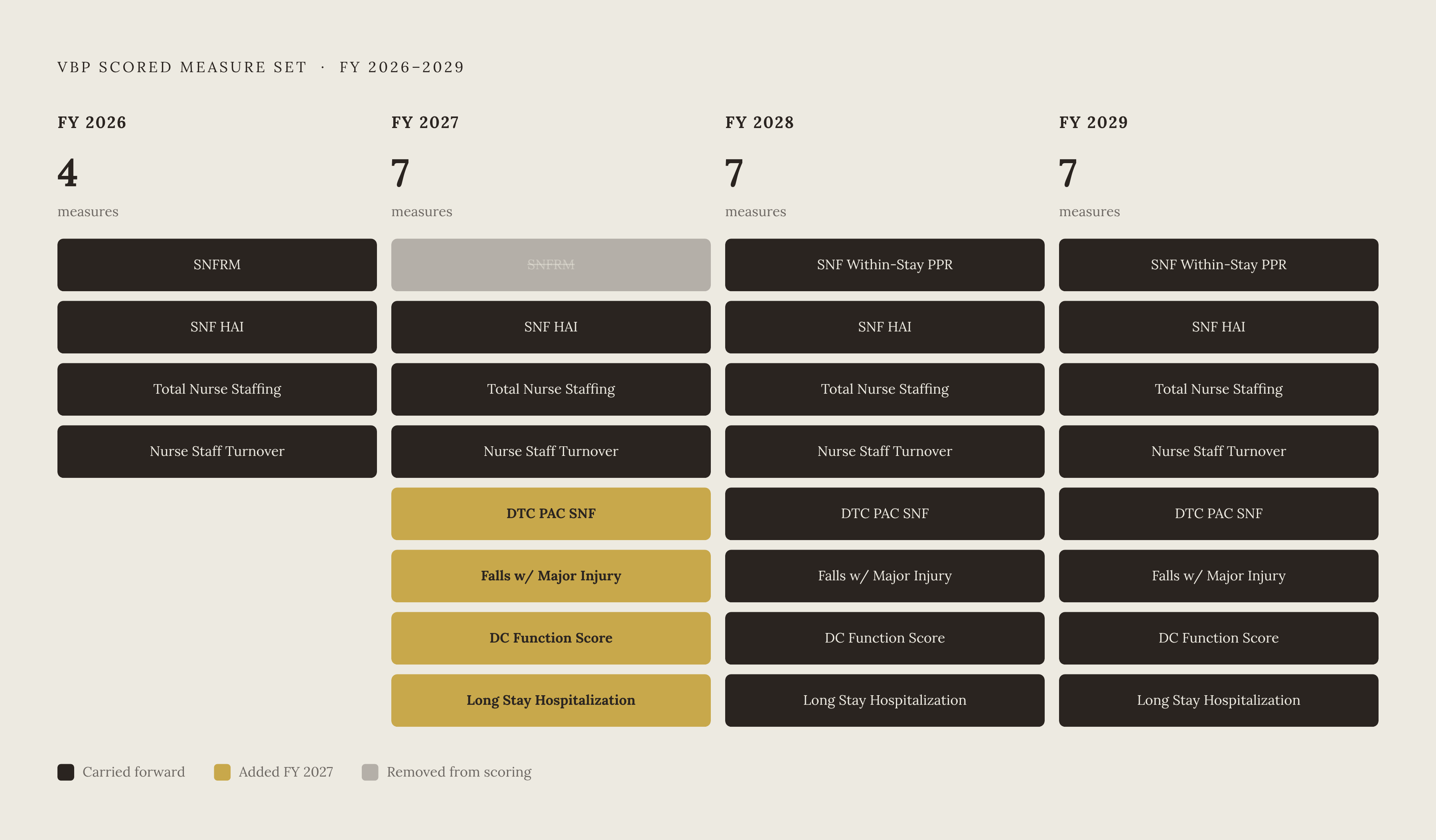
CMS withholds 2% of Medicare FFS Part A payments and redistributes a portion back to SNFs as incentive payments based on performance, with the incentive payment multiplier applied prospectively beginning October 1 of each program year. The scoring structure underneath that withhold-and-redistribute mechanism has changed, and it changes across several years rather than all at once. FY 2027: SNF HAI; Total Nurse Staffing; Total Nurse Staff Turnover; Discharge to Community – Post-Acute Care Measure for SNFs (DTC PAC SNF); Percent of Residents Experiencing One or More Falls with Major Injury (Long-Stay); Discharge Function Score for SNFs (DC Function); Number of Hospitalizations per Long Stay Resident Days (Long Stay Hospitalization).
Starting with the FY 2028 program year, the existing VBP scoring methodology will be applied to the SNF Within-Stay Potentially Preventable Readmissions measure. CMS has already finalized performance standards for FY 2028 and FY 2029 to meet its statutory notice deadlines, and finance teams should incorporate these into multi-year financial models now. Procedurally, CMS also added a new reconsideration step: SNFs can now appeal CMS's initial decisions on Review and Correction requests before the affected data get posted publicly, though taking advantage of that appeal window means someone on the finance team has to be watching iQIES closely enough to catch it in time. VBP measure set by program year (from BerryDunn source table). FY 2026: SNF 30-Day All-Cause Readmission Measure (SNFRM); SNF Healthcare-Associated Infections Requiring Hospitalization (SNF HAI); Total Nurse Staffing Hours per Resident Day; Total Nurse Staff Turnover.
The measure set itself shifts year to year, and the whole sequence needs to be held in view rather than just the year immediately ahead. FY 2028 and FY 2029 then carry forward everything from FY 2027 except the original SNFRM measure, replacing it with the SNF Within-Stay Potentially Preventable Readmissions measure discussed above. Laid out that way, the pattern is less a series of isolated tweaks than a gradual widening of what VBP actually scores, year over year, through the end of the decade. The VBP program requires SNF finance teams to maintain a multi-year calendar because CMS has finalized performance standards and scoring methodology changes that extend through FY 2029, and the Health Equity Adjustment removal in FY 2027 changes how total performance scores are calculated beginning that year. Health Equity Adjustment (HEA): removed from the VBP scoring methodology beginning with the FY 2027 program year, streamlining scoring and altering the calculus for facilities that previously relied on the HEA to boost their performance score (per BerryDunn, Polaris Group, Applied Policy).
The QRP non-compliance notification on August 5, 2026 and its meaning for FY 2027 payment
October 1, 2025 was the effective date. It was never the finish line. Any facility that received one of those notifications is now looking at a 2% reduction to its FY 2027 Annual Payment Update unless it pursues reconsideration successfully.
Why does this date matter so much for a rule that technically took effect nearly a year earlier? That's the moment the QRP consequences of that FY 2026 rule stop being theoretical: a facility's compliance status becomes an actual payment reduction, applied to its Annual Payment Update. Finance teams that weren't actively watching iQIES Provider Preview Reports may have missed the notification altogether, since the alert went out through both iQIES and the MACs rather than through a single obvious channel. That matters because the clock on reconsideration doesn't wait for someone to notice. The 30-calendar-day extension window runs from the date of written notification. For anything distributed on or around August 5, 2026, that window is either closing fast or has already closed by the time a facility's finance team gets around to reading the letter.
Even for facilities that catch the notice in time, the reconsideration standard doesn't leave much room. Full compliance for the applicable program year is what's required for a reversal, and a partial fix, however well-intentioned, does not clear that bar. The FY 2027 impact that follows is direct and mechanical: the Annual Payment Update reduction applies to any facility found non-compliant with CY 2025 QRP requirements, which compresses whatever revenue gain the FY 2026 rate increase was supposed to deliver. One might argue that a single missed notification shouldn't carry this much weight against a whole fiscal year's payment update, but that's how the mechanism is built. The fix, at the operational level, isn't complicated: iQIES monitoring belongs on a standing monthly calendar item, not treated as a reactive task that only starts once a notification letter physically arrives.
MDS Validation Audits: the new audit layer that runs alongside QRP and VBP compliance
CMS introduced MDS Validation Audits, conducted by Healthcare Management Solutions, LLC, with up to 1,500 SNFs randomly selected annually, and any facility selected faces a documentation retrieval obligation with a 45-day turnaround window. That's not a long runway if the requested documentation isn't already organized and accessible.
The same MDS data that determines QRP and VBP performance scores is now also subject to independent verification through audits. Selection is random, and that randomness cuts both ways: a facility with a clean track record and no prior audit activity has no particular protection against being selected next cycle. The practical response is a standing internal process, one that treats monitoring the iQIES Provider Preview Report for audit notifications as routine, and that has documentation retrieval procedures ready to move the moment a notice lands, rather than scrambling to assemble records inside a 45-day window under pressure.
What makes this audit layer worth taking seriously is how the consequences of a documentation gap compound once this layer sits on top of QRP and VBP. A weak documentation practice doesn't produce one adverse outcome. It produces a hit to QRP performance scores and the associated APU penalty, a distortion in VBP incentive payment calculations, and now, potentially, a Validation Audit finding layered on top of both.
Enhanced ownership disclosures shift the compliance frame outward, from what happens inside a single facility's billing and documentation practices to what CMS can see across an entire ownership structure at once. For an operator running one building, ownership disclosure has always been a relatively contained administrative task. For a multi-site operator, though, every facility under common ownership is now part of a single disclosure picture that CMS can cross-reference. An audit finding, a documentation gap, or a compliance lapse at one location no longer stays contained to that location's file.
That is the structural risk. The individual provisions covered earlier, the PDPM mapping changes, the QRP penalty exposure, the VBP scoring shifts, the MDS Validation Audit layer, all operate at the facility level in isolation. Enhanced ownership disclosure connects those facility-level pictures into something CMS can view collectively across a corporate structure. For an operator managing several SNFs under shared ownership, that means the sequencing discipline described throughout this piece, tracking each provision's trigger date, confirming system updates land on schedule, keeping documentation audit-ready, can't be managed facility by facility as separate projects. It has to be managed as one coordinated compliance calendar spanning every site the ownership structure touches, because CMS is now positioned to look at all of them together rather than one at a time.
Sources
- Fiscal Year (FY) 2026 Skilled Nursing Facility (SNF) Prospective Payment System (PPS) final rule | BerryDunn
- Federal Register :: Medicare Program; Prospective Payment System and Consolidated Billing for Skilled Nursing Facilities; Updates to the Quality Reporting Program for Federal Fiscal Year 2026
- CMS Finalizes FY 2026 Payments for Skilled Nursing Facilities, Increasing Payment Rates and Updating Quality Changes - Applied Policy
- Polaris Group | CMS Final Rule for SNFs: FY 2026