Medicare Cost Report Deadlines and Extension Rules
Providers have five months to file, and extensions are narrower than most assume.

Medicare cost report deadlines follow a fixed statutory clock, five months after a provider's fiscal year ends, and the extension rules built around that clock are narrower than most providers assume. This matters because the cost report does two jobs at once: it settles what Medicare owes or has overpaid for the year just closed, and it feeds the data that sets wage indices, DSH adjustments, and GME payments for years to come. Miss the deadline, or file something the MAC rejects, and both timelines get disrupted at the same time.
CMS regulations require annual cost report submission from nearly every Medicare Part A provider. Outpatient physical therapy providers and comprehensive outpatient rehabilitation facilities are excluded, but hospitals, SNFs, home health agencies, hospices, FQHCs, and rural health clinics all file, each on the form built for their provider type. Every one of those reports lands in HCRIS, the Healthcare Provider Cost Reporting Information System that CMS uses for rate-setting and policy analysis. Providers should confirm their specific filing obligations directly with the MAC rather than assume standard requirements apply in all circumstances.
How the five-month rule works in practice
The mechanics are simple to state and easy to underestimate. A cost report is due on or before the last day of the fifth month following the close of the provider's fiscal year. For providers on a non-calendar fiscal year, the rule translates to 150 days after the period ends.
A few concrete examples make the pattern clear. A fiscal year ending December 31, 2025 produces a due date of June 1, 2026. A June 30, 2026 year-end pushes the deadline to November 30, 2026. September 30, 2026 lands the report on March 1, 2027. Calendar-year providers, the largest group, generally owe their report by May 31 of the following year, though if that date falls on a weekend or federal holiday, the deadline rolls to the next business day automatically. That shift isn't a courtesy the MAC extends, it's built into the rule.
Change of ownership complicates the calendar. When a CHOW occurs, or a Medicare Provider Agreement terminates, the five-month (or 150-day) clock restarts from the date specified in the CMS or MAC notice of that event. A facility that changes hands mid-year suddenly has a cost report deadline that has nothing to do with its usual fiscal calendar, and providers going through a transaction need to recalculate rather than assume the old due date still holds.
What counts as "filed" is stricter than it sounds. A draft sitting in a folder, a report half-uploaded, none of that satisfies the requirement. The report has to be mailed or fully uploaded to MCReF, and if it's electronic, the upload must be complete and electronically postmarked by 11:59 PM Eastern on the due date. Given how long it takes to gather wage data, PS&R figures, and patient-day totals, five months from year-end is less runway than it looks like on paper. That compression is why understanding extensions, covered further down, is worthwhile to do well before the deadline arrives rather than during the week it does.
The electronic filing system and one new data-pull shortcut
MCReF, the Medicare Cost Report e-Filing system, already lets every Medicare Part A provider file the entire cost report package electronically, supporting documentation included, straight to the MAC. That much has been true for a while. What changed in 2026 is smaller but genuinely useful: a one-click PS&R download built into MCReF itself.
CMS Manual System CR13617, tied to Change Request 14351, notified MACs that PS&R summary reports have been available for one-click download inside MCReF since May 13, 2025. The output is equivalent to what a provider would get from the full PS&R system, and it's built to be ready for cost report vendor software without extra formatting. Instead of submitting a custom request and waiting in a queue, or hunting through a multi-screen request process, a provider can pull the report from a single screen and move straight into preparation.
That sounds like a minor workflow tweak, but PS&R data gathering has historically been one of the slower steps in cost report prep. Shaving time off it matters most for providers running close to their five-month deadline, and it should factor into any internal conversation about whether an extension request is actually necessary or whether the timeline can be met with better tools.
None of this changes the completeness standard. A report that comes back from the MAC because of missing or incorrect elements is treated as though it was never filed, full stop. Rejection isn't a grace period, and providers shouldn't treat it as one. Once a report is accepted, finalization follows CMS Internet-Only Manual, Publication 100-06, Chapter 8, Section 90; if the report is pulled for a limited or full audit review, CMS finalizes it within 60 days of the final exit conference.
When extensions are available and what qualifies as extraordinary circumstances
Extensions exist, but the bar is high on purpose. CMS guidance grants extensions only for something that significantly disrupts a provider's operations and sits outside the provider's control. The examples CMS actually points to are things like floods and fires, events that shut down a facility's ability to function, not events that merely slow down an accounting department.
What doesn't qualify is just as important to understand. Being understaffed, having software problems, running into an ordinary audit delay: these get cited constantly in extension requests, but none of them are guaranteed grounds for approval. A provider planning around the assumption that an extension will bail it out if things get tight is planning on a coin flip.
The process itself has real requirements. The request has to go in writing before the deadline, not after, and it goes to the provider's MAC along with documentation substantiating the disruption, whatever that looks like for the circumstance in question. The MAC can approve or deny; anything beyond the MAC's own authority needs CMS sign-off directly. Noridian, as one MAC example, requires providers to complete a Cost Report Extension Request Form and email it to a dedicated address, signed by an Authorized Official or Administrator listed on the provider's Medicare enrollment record. Other MACs run their own versions of this process, so confirming the specific form and signature requirement in advance saves a scramble later.
One extension actually happens automatically, and providers should track it closely: if the MAC itself fails to deliver the PS&R report by the 120th day after the cost reporting period closes, an automatic extension kicks in. That's one of the only non-discretionary extensions built into the system, which makes it worth a provider's time to simply track whether the MAC is hitting its own delivery deadline.
CMS also issued a blanket 60-day extension for cost reports covering periods ending between March 1 and December 31, 2020, tied to pandemic disruption. As of late 2026, nothing comparable has been confirmed for reporting periods in 2026. Providers shouldn't assume that pattern will repeat; they should check directly with CMS rather than bank on history rhyming.
Grace periods and extensions aren't the same thing either. A grace period for resubmission only applies when the original report was filed on time. File late, and that cushion disappears.
Consequences of a late or deficient cost report
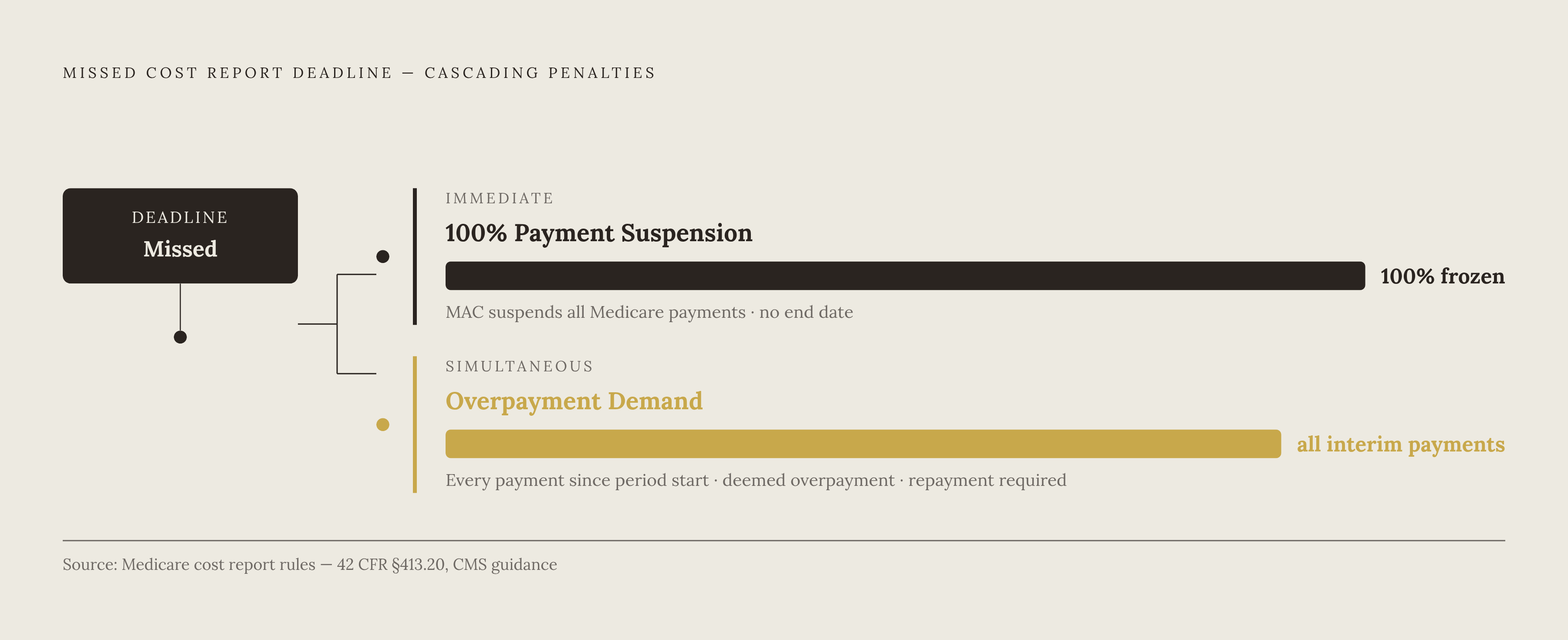
The penalty structure here is mechanical. The moment a report is considered late, the MAC is required to suspend 100% of the provider's Medicare payments. That's not a judgment call by anyone at the MAC; it's what the regulation demands.
That suspension doesn't come with a built-in end date. It stays in place until an acceptable cost report is submitted and processed, and how long that takes depends entirely on how fast the provider can produce something compliant. On top of that, missing the deadline means every interim payment the provider has received since the start of the cost reporting period can be deemed an overpayment, which creates a repayment obligation layered on top of the frozen future payments. Two financial problems, arriving together, from a single missed date.
Rejection for deficiency and late filing aren't quite the same failure, though they can collapse into each other quickly. A report bounced back for missing or incorrect elements comes with a letter from the MAC spelling out what needs fixing. But if the due date has already passed by the time that rejection gets processed, the provider is now looking at withheld payments, interest, penalties, and potential repayment demands.
The exposure is worse for providers whose whole reimbursement model depends on cost reporting. Critical Access Hospitals, FQHCs, and RHCs don't just risk a payment delay if they file late, they risk losing cost-based reimbursement status. For these provider types, the cost report deadline is structural to how they get paid.
Any provider who sees a deadline slipping needs to request an extension before the due date, even without certainty it'll be approved, because a denied extension request still leaves the provider in a far better position than a late filing does.
A new 2026 reporting requirement that acute care hospitals need to plan for now
The finalized 2026 OPPS rule adds a genuinely new reporting obligation for acute care hospitals reimbursed under IPPS. Starting with cost reporting periods ending on or after January 1, 2026, these hospitals have to report median negotiated payment rates from Medicare Advantage plans, broken out by MS-DRG, on the annual cost report itself.
The vehicle for this is Worksheet S-12, a worksheet that didn't exist before this rule. Hospitals report the median negotiated rate for every MS-DRG where they have data available in their most recent hospital price transparency machine-readable file. That means the number isn't something finance can pull from existing cost report inputs, it has to be calculated fresh by arraying every payment occurrence for a given MS-DRG from lowest to highest and finding the midpoint.
General acute care hospitals under IPPS across all 50 states, DC, and Puerto Rico are on the hook. Critical access hospitals, rural emergency hospitals, and facilities that don't negotiate rates with Medicare Advantage plans (certain Indian Health Service hospitals, and hospitals under Maryland's Total Cost of Care Model, among them) are exempt. For hospitals with fiscal years closing in early 2026, this data has to be ready in time for cost reports due mid-year, which doesn't leave much runway once the requirement is fully understood.
Pulling this off requires coordination that goes well past the finance department. Revenue cycle has to supply discharge records, managed care contracting has to reconcile the MRF data against actual negotiated terms, and compliance has to sign off that the methodology holds up. It's not a single-department task, and treating it as one is probably the fastest way to get it wrong.
The long game here is rate-setting. CMS plans to use the Worksheet S-12 data to inform future IPPS MS-DRG relative weights, with Fiscal Year 2029 cited as a likely starting point. That means today's reporting accuracy could directly shape a hospital's reimbursement years down the line, which raises the stakes on getting the median calculation right the first time. There's also an upside buried in the compliance burden: once this data sits in HCRIS, hospitals will be able to benchmark their own MA contract terms against peer institutions, something that hasn't really been possible using cost report data before.
Where auditors focus once the cost report is filed
Filing accurately and filing on time are two different achievements, and the second one doesn't guarantee the first. Worksheet S-10, the schedule tied to uncompensated care and DSH payments, is an area where the documentation behind charity care and bad debt figures warrants careful attention, not just the totals themselves.
GME and IME reporting carries complexity worth noting. Resident counts involve detailed rules, and errors in how graduate medical education payments or indirect medical education costs get reported have appeared in audit findings alongside Medicare bad debt figures.
SNFs carry their own set of pressure points. Therapy costs need to be reported in the appropriate categories rather than folded into nursing or administrative lines. Contract labor, meaning agency staffing, needs its own line separate from regular salaries, a distinction that reviewers have flagged in audit findings. Patient-day totals need to tie out against census logs and payer records, because any mismatch invites a closer look. Capital and lease accounting, particularly depreciation errors, ripples into rate-setting and financial ratios in ways that aren't always obvious until an auditor flags them.
Related-party transactions deserve particular caution. Plenty of SNFs lease from an affiliated real estate company, or contract with a related management or staffing firm, and Medicare's rule here is specific: the cost report has to reflect allowable costs under Medicare's related-party rules rather than inter-entity rates that may exceed those limits. Get the documentation wrong, and the result can be inflated reimbursement that turns into an audit finding, or worse, a repayment demand. The OIG currently has 13 active workplans focused on nursing homes, some dating back to 2022 and 2023, still active and carried forward into reviews through 2026.
PDPM changed the structure of SNF reimbursement, and the cost report categories that matter most shifted along with it, cost allocation and patient-day tracking carry more weight than they used to. The OIG continues to carry forward active workplans focused on nursing homes. A cost report can be timely, complete, and still trigger exactly this kind of scrutiny if the underlying allocation choices don't hold up.
SNF and Illinois-specific rule changes providers cannot miss in 2026
SNFs are moving to a new cost report form. The CMS-2540-24 replaces the older CMS-2540-10, and any provider still submitting on the old structure risks rejection, which as covered earlier, counts as not having filed.
The FY 2026 SNF payment rule, includes a 3.0% market basket increase to SNF payment rates, alongside updates to the SNF Quality Reporting Program and the SNF Value-Based Purchasing Program. Those notifications aren't just a paperwork flag, they carry forward into the FY 2027 Annual Payment Update calculation.
Illinois providers face a distinct set of changes layered on top of the federal rules. Long-term care facilities and supportive living facilities on a calendar fiscal year now share a single unified filing deadline of May 31, 2026 for their 2025 cost reports, a consolidation from the separate deadlines these facility types used to file under. Illinois HFS has also signaled it plans to enforce that deadline strictly, granting extensions only in limited circumstances, so the old habit of assuming some flexibility exists probably needs to be retired.
Ownership disclosure requirements expanded too. Where HFS used to require disclosure only for the operating company, providers now have to disclose ownership for the OpCo, any related property or building company, and any related management company or office, wherever those relationships exist. That's a meaningfully wider net than before.
Supportive living facilities face the steepest jump in documentation burden. HFS has introduced a new mandatory template, and facilities still submitting older formats will be rejected outright, no exceptions built in for a transition period. The new template calls for Schedule V covering detailed cost center expenses, Schedule VII for related organizations and compensation, Schedule VIII for indirect cost allocation, Schedules XI through XII for capital and asset reporting, Schedule XVIII for staffing and salary detail, and separate real estate tax statements. Facilities that underestimate how much documentation that represents are looking at two compounding risks at once, rejection under the new template and payment suspension tied to the tighter deadline, and both need to be planned for together rather than addressed one at a time.
Building a filing process that treats deadlines as the outcome of
A cost report deadline met at the last possible hour is still, technically, met. That last-minute scramble costs a provider more than just stress: less time to catch an S-10 documentation gap, less room to double-check that related-party costs are reported at true cost rather than marked-up intercompany rates, no buffer if the MAC's PS&R data comes in late.
The deadline itself isn't really the hard part. Five months, or 150 days for non-calendar years, is a known quantity that appears on the calendar the moment a fiscal year closes. Hitting that date cleanly depends on what happens in the months before it: pulling PS&R data early using the new MCReF one-click download, separating therapy costs from nursing costs as they're recorded rather than reclassifying them at the last minute, and starting Worksheet S-12 data collection for hospitals alongside routine revenue cycle work instead of as a separate scramble bolted on afterward.
Treated this way, the deadline is no longer the thing a provider is racing toward but a checkpoint, a date that confirms whether the year's data discipline actually held up. Providers who build toward that checkpoint all year, rather than sprinting for it in month four, tend to be the ones who never need their MAC's extraordinary circumstances standard to show any flexibility.
Sources
- Medicare Cost Report Due Dates
- Medicare Cost Report Extension 2025: Stress-Free Guide
- Understanding the New Medicare Advantage Reporting Requirement for Cost Reports
- Medicare Cost Report Due Date 2025: A Guide for Providers
- Healthcare Financial Solutions | Health Financial Solutions
- Cost Reports - JE Part A - Noridian
- Medicare Cost Report Electronic Filing (MCReF) | CMS
- federalregister.gov