How the Annual Survey Discipline LTC CFOs Live by Maps to a Freddie Mac Seller-Servicer Compliance Audit
LTC CFOs already have the habits Freddie Mac audits demand.

Mortgage banking audit and compliance services for independent mortgage bankers require more than an annual financial-statement audit. LTC CFOs already have the discipline a Freddie Mac Seller-Servicer compliance audit calls for, with written policies, controls that run continuously, and evidence ready when asked for. They need to fit that discipline to Freddie Mac’s framework and meet its specific financial, information-security, and AI governance requirements.
Why LTC CFOs already operate inside a permanent audit posture
An LTC CFO cannot safely say that the audit is three months away. A surveyor may arrive before the finance team finishes reconciling records or documenting a correction. For the finance leader, that means written procedures, current accounting records, and evidence of remediation must remain available between inspections, rather than being assembled when an inspection approaches.
CMS’s nursing home certification page establishes the timing that produces this discipline. Each state must complete a standard survey of every SNF/NF no later than 15 months after the previous survey, with the statewide average interval not exceeding 12 months. Those intervals do not provide an appointment. Surveys are unannounced and can start at any hour, including weekends and outside normal business hours. Certification requires at least a Life Safety Code survey, a Standard Health Survey, and an Emergency Preparedness Survey.
CMS Admin Info 26-06-NH requires federal validation of at least 5 percent of the SNFs surveyed by each state annually, never fewer than five per state. Health Comparative Federal Monitoring Surveys must occur within 60 calendar days of a state survey exit. Meanwhile, CMS QSO-25-07-NH revised surveyor guidance effective April 28, 2025, across domains including QAPI and Infection Prevention. The CFO therefore faces both recurring scrutiny and changing requirements.
What a Freddie Mac Seller-Servicer compliance audit actually requires
Freddie Mac requires each Seller/Servicer to put written policies and procedures in place, keep them up to date, and use them to meet the laws that apply and Freddie Mac’s requirements. The multifamily requirements cover origination, underwriting, servicing, asset management, and investor reporting of mortgages and properties. Those policies must be available upon request. Their existence is only the starting point, because the compliance review tests whether the written controls have operated continuously.
Audited financial statements must be free of material weaknesses, and the entity must show that it has sufficient capitalization. Freddie Mac’s review arrives on its timetable. An entity reviewed in 2025 received an overall assessment of “Satisfactory.”
What happens when an entity cannot keep its approved status? The entity could no longer sell mortgage loans to Freddie Mac. Separately, breaches of representations, warranties, or servicing obligations can require repurchase of previously sold loans and may lead to suspension or disqualification. A compliance deficiency is therefore not just an unfavorable observation in an auditor’s report.
The structural parallel between survey readiness and Seller-Servicer compliance
The first correspondence is between policies that exist before an examination begins. LTC survey discipline calls for written procedures for each area under regulation, while Freddie Mac requires written procedures for the mortgage activities it oversees. Both require retrieval on demand. A policy that management intends to finish before the next review cannot serve the same purpose as one already governing daily work.
The second correspondence concerns operation between examinations. LTC surveyors assess whether actual practice matches policy during an unannounced visit. Freddie Mac’s Single-Family Seller/Servicer Guide reserves the right to conduct its own assessment or designate a third-party assessor to evaluate a servicer’s security and compliance practices. The timing is not management’s to control. In each setting, a control has to be running when scrutiny begins.
The third correspondence is evidence that withstands outside review. LTC financial discipline includes GAAP-compliant records, separate resident accounting, and documentation of payor settlements, while Freddie Mac requires audited financial statements free of material weaknesses. But does that make a clinical survey equivalent to a mortgage audit? Not in scope or testing. The structural match lies in the relationship between policy, practice, and proof, so a living policy binder and a documented Plan of Correction provide a working model alongside the required mortgage-specific evidence.
Where HUD 232 debt makes the parallel explicit and the stakes concrete
For an LTC operator with HUD 232 debt, survey readiness and lender compliance intersect. The state survey becomes a clinical inspection, a financial reporting document, and an underwriting input. Under 24 CFR 5.801, entities with Section 232-insured mortgages must send annual GAAP financial statements to HUD within the set time after fiscal year-end. Separate quarterly reporting requirements also apply.
The HUD lender must review findings from the most recent Life Safety, Complaint, and State Annual Surveys and check for unresolved findings. Those findings inform underwriting and servicing decisions. An unresolved survey tag can therefore affect what the lender reports to HUD and, where the lender is also a Freddie Mac Seller/Servicer, its compliance file. The survey report does not stay inside the facility. Its unresolved issues travel into the financing relationship.
HUD OIG’s audit issued April 2, 2026, found that ORCF had not always acted on financial risks already disclosed in borrowers’ audited statements. Disclosure alone had not produced a sufficient response. For the CFO receiving survey findings, the practical implication is to document remediation as well as submission. Where the operator also originates or services HUD 232 multifamily debt, a deficient survey can threaten the operating license while impairing the financial statements supporting Seller/Servicer approval.
How tax structure and related-party arrangements surface in both audits
SNF ownership commonly separates the operating entity from the property entity through an OpCo/PropCo structure. The lease connects their accounts. Rent flows through the operator’s income statement and affects the debt-service-coverage calculation that a Freddie Mac servicer relies on, so related-party terms matter both in the records of ownership and in the lender’s review.
Consider a related-party lease whose terms on the tax return do not reconcile with the audited financial statements. That gap can flag a deficiency in both a HUD audit and a Freddie Mac compliance review. Pass-through income allocations require the same consistency. For owners pursuing a Section 232/LEAN refinance, clean GAAP-compliant numbers and dependable annual reporting therefore depend on coordination between tax and audit advisors. A tax election can create a reconciling difference that requires explanation, so the CFO’s documentation discipline must extend from the survey file into the return preparation cycle.
SOC 2 requirements and what they add to the compliance spine
Freddie Mac’s SOC 2 requirement adds information-security assurance to the financial control environment. Seller/Servicers whose annual servicing portfolio meets or exceeds the applicable threshold must undergo an annual SOC 2 Type 2 examination. The examination assesses control design and operating effectiveness over no less than six consecutive months. The servicer must provide the full, unredacted final report, management response, and relevant remediation plans within thirty (30) days of issuance.
Operators that use third-party billing services, EHR platforms, or revenue cycle management vendors already seek SOC 1 reports on controls over financial reporting. SOC 2 addresses information-security controls instead.
Freddie Mac’s Guide Section 1302.2 makes the obligation apply to vendors as well, starting January 1, 2027. Servicers subject to the SOC 2 Type 2 requirement must ensure that third-party vendors processing, storing, or transmitting Freddie Mac’s proprietary information maintain SOC 2 Type 2 compliance or applicable equivalents, including ISO 27001 or PCI DSS. For an LTC-adjacent CFO, independent verification is familiar, but the scope of that verification must now reach beyond financial reporting.
AI governance requirements and the quarterly retesting cadence that eliminates pre-audit scrambles
Freddie Mac’s Guide Bulletin 2025-16, issued December 3, 2025, amended the Single-Family Seller/Servicer Guide to impose governance, audit, and security requirements for AI and ML systems, effective March 3, 2026. Those requirements call for ongoing monitoring for performance degradation, bias, and security issues, along with regular internal and external audits that check the systems against recognized standards. Annual preparation is insufficient for ongoing monitoring. The evidence must address how the systems are governed between formal reviews.
The AICPA’s TQA Section 9561, issued in September 2026, provides nonauthoritative guidance on how a service organization’s use of AI affects SOC 1 and SOC 2 examinations. As of October 2026, the joint AICPA/AIUC offering combines a SOC 2 report and AIUC-1 certification of named AI agents in a single accountant-led engagement and report. A full launch is planned for early 2027. These developments connect AI-specific testing to assurance structures finance leaders already recognize.
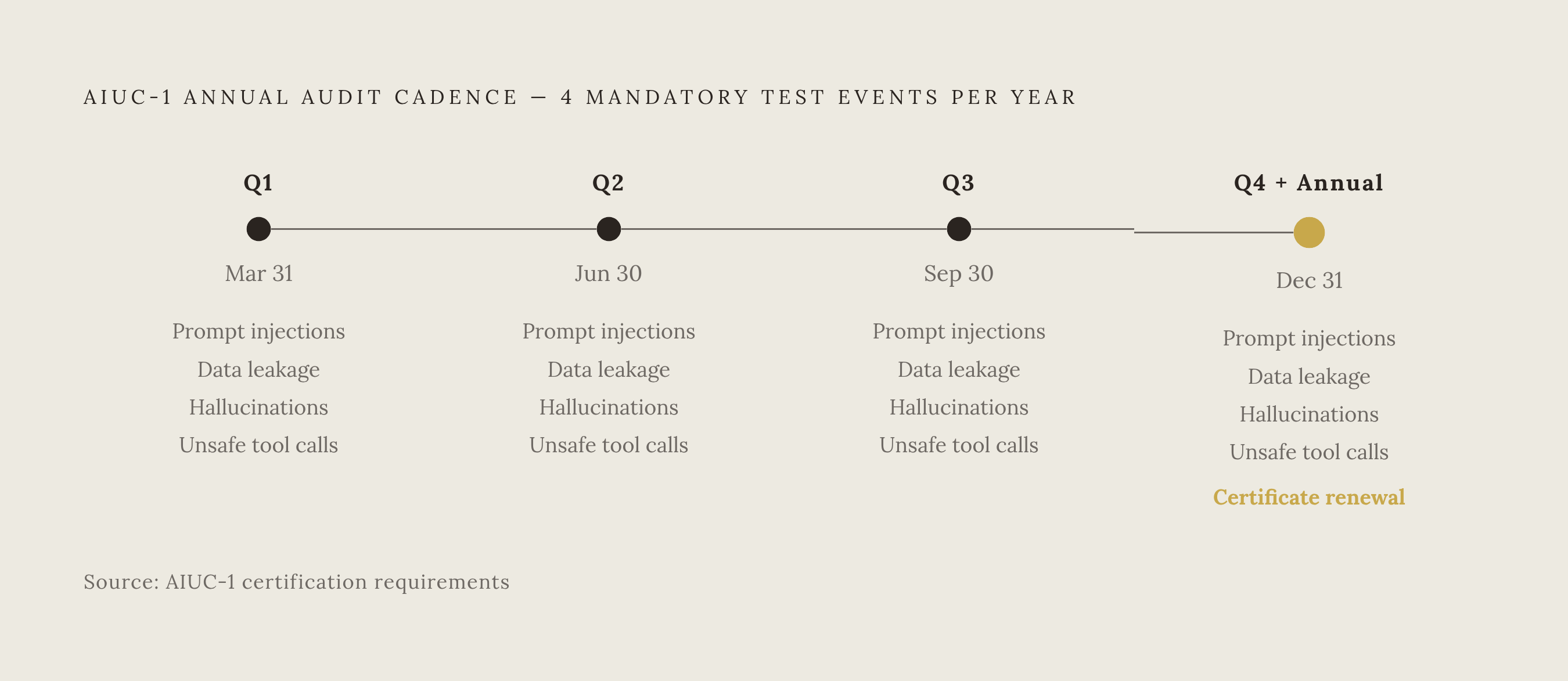
AIUC-1 adds a more demanding testing rhythm. It requires technical retesting every quarter as well as the annual certificate, so each certified AI agent goes through at least four audit-grade events per year. Testing evaluates adversarial prompt injections, data leakage, hallucinations, and unsafe tool calls. Does that make certification a universal Freddie Mac requirement? The distinction is important, because Freddie Mac’s ongoing governance obligations and AIUC-1’s certification cadence are related but separate requirements.
The standard applies in the same way across industries, so LTC billing AI tools and mortgage origination or servicing AI platforms come under the same framework when certified under it. Familiarity with unannounced surveys provides a useful foundation, but it does not establish that technical retesting has occurred. That work still requires its own evidence. For a program operating under AIUC-1, quarterly retesting makes always-on compliance a structural requirement.
What the LTC CFO needs to do differently — and what already transfers
An LTC CFO moving into a Seller/Servicer role needs to map the controls already in place before assuming that all of them transfer or that none do. Retrievable policies, real-time GAAP-compliant records, documented remediation, and independent vendor control reports already provide the foundation. The mortgage framework supplies the new specifications. The mapping must connect those habits to the relevant origination, servicing, reporting, and security obligations.
Capitalization and liquidity need separate attention because they have no direct LTC survey equivalent. Freddie Mac’s updated minimum liquid assets requirement takes effect December 31, 2026, and sets both a minimum cash balance and a floor for the cash-over-expenses ratio. The CFO must coordinate monitoring with the entity’s tax and audit advisors on a fiscal-calendar basis. Information security requires an extension as well. SOC 2 Type 2 and the obligations that apply to downstream vendors cover data handling and business operations beyond the SOC 1 reviews many LTC operators know, while AI governance needs its own monitoring and testing.
How should a buyer assess mortgage banking audit and compliance services for independent mortgage bankers at this intersection? The selection criteria should distinguish financial-statement audit capability from outsourced internal audit, QC, and compliance support. For an LTC-adjacent entity, the advisor must understand both SNF regulation and the Freddie Mac Seller/Servicer framework that applies to it. Scope deserves explicit discussion before engagement. The useful test is whether the advisor can translate existing evidence into those requirements, identify the gaps, and provide proactive, year-round advice.
Sources
- DEPARTMENT OF HEALTH & HUMAN SERVICES Centers for Medicare & Medicaid Services
- Nursing Homes
- Revised Long-Term Care (LTC) Surveyor Guidance
- Medicare State Operations Manual
- CMS Releases FY2026 Guidance for Federal Monitoring Surveys in Nursing Homes
- Appendix B to August 25, 2026 Bulletin: Redlined Guide Chapter Changes