How LTC Technology Vendors Turn SOC 2 Into a CFO Conversation About Resident Data Stewardship Not Vendor Paperwork
A vendor's SOC 2 report is evidence of resident data protection.

SOC 1 and SOC 2 examinations build trust when technology vendors show how tested controls address the buyer’s exposure, instead of using the reports as paperwork for the purchase. For long-term care CFOs, SOC 1 addresses controls relevant to financial reporting, while SOC 2 addresses protection of sensitive resident information. Leaders must assess whether the evidence supports entrusting a vendor with data belonging to people in the operator’s care.
Why LTC technology vendors hold an unusual concentration of sensitive resident data
Residents in long-term care often cannot easily advocate for themselves when their personal information is exposed or misused. Their records combine clinical histories, Medicare identifiers, functional assessments, and financial account information. These are not isolated fragments of a life. Together, they describe a person’s health, identity, financial circumstances, and dependence on others. A technology partner that holds those records therefore has a duty that goes beyond keeping a generic business application running.
The documentation itself deepens that responsibility because long-term care records accumulate throughout daily life. Certified nursing assistants generate most clinical data across three shifts, recording meals, mobility, medications, behaviors, and vital signs. Standardized resident assessments take place on a set schedule, while revenue depends directly on acuity scores calculated from the same information. One record serves several consequential purposes. Compared with a typical outpatient encounter, the resident’s daily documentation creates a much larger individual data footprint.
That concentration also extends beyond individual facilities. The Long-Term Care Data Cooperative assembles electronic health record data across organizations for uses including population health, surveillance, and research. Aggregation can support improvements in care, but it also increases the concentration of sensitive information. Finance leaders should oversee stewardship of that data because the vendor’s security posture affects both vulnerable residents and the institution responsible for their care.
How the LTC software market's growth is widening the data surface vendors must protect
Cloud-based deployment held the largest delivery-mode share of the LTC software market in 2025 and was growing fastest. More resident information is therefore moving onto vendor-managed infrastructure as the market expands. The responsibility does not stop at the hosting boundary. Interoperability, AI, and real-time exchange let systems do more while adding routes through which resident information moves.
CharmHealth and PointClickCare announced a bidirectional EHR integration in January 2026 to enable post-acute care data exchange. PointClickCare also formed a strategic partnership with WISHIN that month to support real-time exchange and smoother care transitions. Each new connection broadens the perimeter that a vendor’s assurance evidence needs to address.
For a CFO, the useful question is not simply whether the platform has become more capable. Has the evidence about its controls expanded with it? An integration may introduce a subservice organization whose role needs to be addressed in the SOC 2 report. A report that leaves those organizations unexplained gives the operator an incomplete picture, even if it accurately describes controls within the vendor’s own environment. As the platform grows, the operator must keep checking its controls after the contract is signed.
What SOC 2 actually examines, and why the Type II distinction matters for LTC CFOs
The AICPA’s SOC 2 framework assesses service-organization controls against five Trust Services Criteria, which are security, availability, processing integrity, confidentiality, and privacy. The criteria establish what can be examined, but the report’s scope determines what was examined. That distinction is essential to reading the evidence. A report should not be understood as assurance about every aspect of a platform merely because it bears the SOC 2 name.
The report type answers a separate question about time. Type I assesses control design at a point in time, while Type II assesses both design and operating effectiveness over a defined period. Type II requires evidence that policies, logs, and processes supported the controls while they were in use. Design alone cannot establish that distinction. Healthcare buyers therefore generally seek Type II reports, even though SOC 2 attestation is not legally required.
SOC 1 serves the same CFO but addresses a different exposure, namely whether a vendor’s controls could compromise the operator’s financial reporting. SOC 2 addresses the protection of sensitive information. Neither should be confused with the contractual relationship established by a Business Associate Agreement. A BAA defines a legal relationship, but it does not describe the vendor’s actual control environment. The Type II report supplies independent evidence about that environment within its stated scope and period.
Why a vendor breach is the LTC operator's regulatory and financial problem regardless of where it originates
The HIPAA Breach Notification Rule requires covered entities to notify affected individuals, HHS, and in many cases the media, including when the breach originates at a vendor. Outsourcing the system does not remove that obligation. The operator can still face enforcement, damage to its reputation, and financial losses, even when the compromise starts outside its network. That is the pivot from vendor evaluation to fiduciary oversight.
The Oncology Institute’s May 2026 breach involved a third-party vendor compromise. NYC Health + Hospitals reported to HHS in March 2026 and publicly confirmed in May 2026 that unauthorized access to its network followed a third-party vendor compromise, with millions of affected individuals reported to HHS. The vendor relationship did not isolate the provider from the consequences of compromised patient information.
Radiology Associates of Richmond illustrates a different breach route and the speed of the legal response. Its notice placed unauthorized access to its own network on or around July 25, 2025. The forensic investigation concluded on April 6, 2026, finding that files had been acquired without authorization, and patient notification began on May 21, 2026. A class action filing followed within days. This internal-system breach demonstrates how quickly notification can become litigation.
Healthcare breaches have the highest average cost of any industry, making contractual reassurance an insufficient basis for financial judgment. Standard BAA language often does too little to address what happens when information is exposed. A Type II report can provide independent evidence about whether the vendor’s controls operated effectively before the operator must rely on them.
How HUD 232 financing compounds the technology vendor risk for SNF operators
Not every LTC operator has HUD financing, but skilled nursing facilities with HUD Section 232-financed properties face an especially direct connection between technology availability and financial compliance. Federal regulation 24 CFR 5.801 requires audited financial statements on a set schedule, with a firm 90-day deadline to submit them after each fiscal year ends. The reporting clock does not accommodate a vendor disruption. EHR and revenue cycle systems supply the census data, PDPM acuity scores, and billing records that feed those statements.
The exposure also concerns the integrity of the underlying records. HHS-OIG audited a single New York skilled nursing facility in November 2025 and recommended repayment of tens of millions of dollars in improper Medicare payments. The audit was the first in an ongoing series targeting SNFs under PDPM. That finding shows the financial stakes attached to billing whose support depends on clinical documentation and MDS data, without establishing a vendor-control failure.
A control gap affecting that data can therefore ripple into a billing finding, while lost access can threaten timely reporting. Skilled nursing compliance connects billing accuracy, False Claims Act exposure, documentation, staffing reporting, and data security. A failure in one area can become evidence in another. For HUD-financed operators, vendor assurance needs to be part of compliance work because the same records are at risk when technology or financial reporting fails.
Does a vendor’s SOC 2 report actually show that its controls are sound?
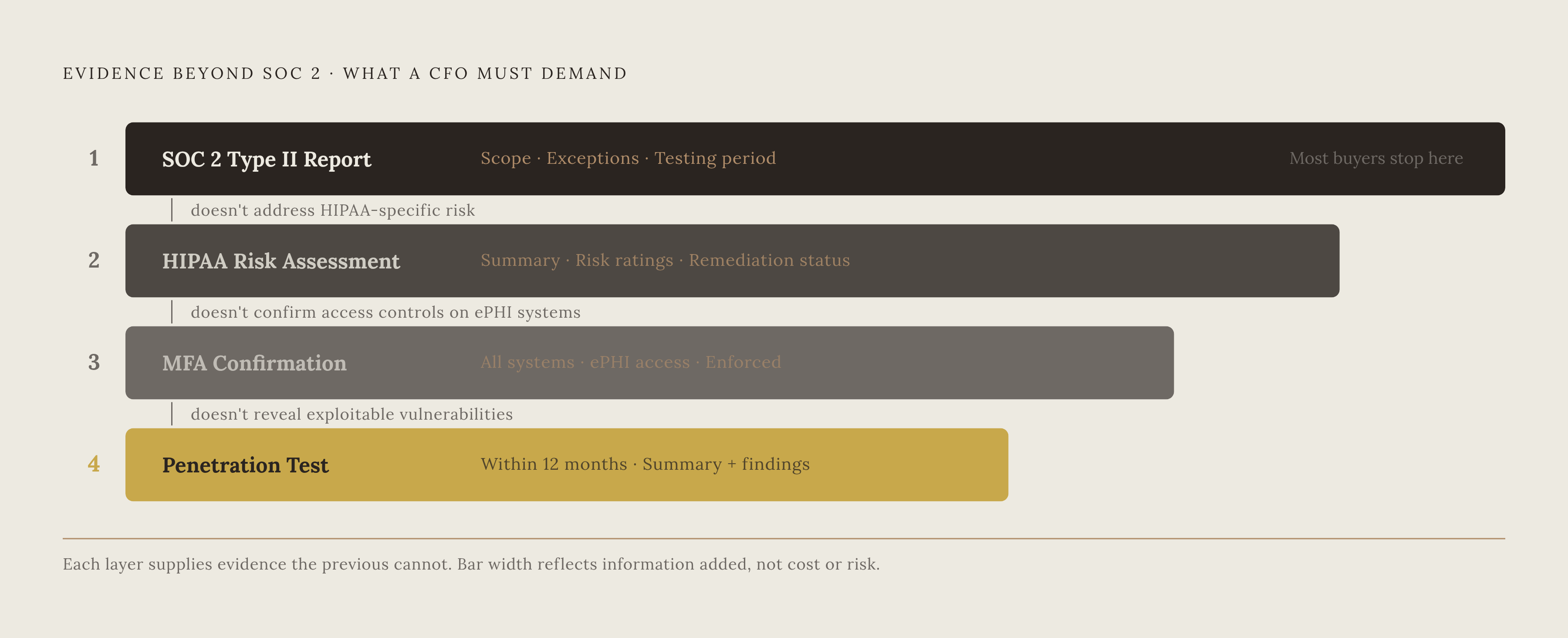
Possession of a report does not answer that question. Its scope, testing period, exceptions, and auditor independence determine how much confidence a CFO can reasonably place in it. A documented exception may reveal a weakness relevant to the operator’s environment, but its significance depends on the affected control and the exposure it creates.
Scope deserves the same scrutiny as exceptions. An accelerated or low-cost examination that covers only security, while excluding availability, confidentiality, and privacy, does not establish protection across the resident data lifecycle. That omission is especially consequential where financial reporting depends on system access. A report that covers one environment also may leave questions about newly connected services unanswered.
For high-risk vendors, the recommended evidence extends beyond a current Type II report. Healthcare organizations should also request the latest HIPAA risk assessment summary, confirmation of multifactor authentication on systems handling electronic protected health information, and a penetration test summary from within the past year. These requests supply distinct pieces of evidence. If the vendor cannot produce them, the documentation gap is itself a finding rather than a reason to assume the underlying controls are sound.
These requests can put strain on the relationship with a vendor. But the operator still has duties when a breach occurs, however easy the purchase was. For a SaaS vendor seeking enterprise trust, relevant evidence and a clear response to exceptions offer a stronger basis for the buying decision than an unqualified claim of being compliant.
How the proposed HIPAA Security Rule update formalizes what leading LTC operators are already doing
HHS Office for Civil Rights put out the proposed HIPAA Security Rule update in January 2025. Its initial finalization target of May 2026 was later pushed to July 2027. The proposal supports a more documented, evidence-based relationship between covered entities and business associates.
The proposed update would make nearly all previously “addressable” safeguards mandatory. It would also require written technology asset inventories and network maps that show how electronic protected health information moves. Those documents help show where systems start and end, which a thorough examination of SOC 2 scope also needs to make clear. Business associates would additionally have to provide covered entities with written evidence of compliance testing.
The proposal does not make a SOC 2 report a substitute for HIPAA compliance. Instead, it strengthens the rationale for the documentation requests that careful operators already make. Organizations with Type II review and supplemental evidence embedded in vendor management would have less catch-up work if the requirements are finalized as proposed. Operators should build that discipline ahead of finalization, while treating the timetable and final requirements as unsettled.
Why AI features in LTC platforms create a gap that SOC 2 alone cannot close
An LTC platform can have tested infrastructure controls without establishing that an AI feature behaves safely or reliably. SOC 2’s five criteria were designed for human-operated system controls. They do not directly assess AI model behavior, training data integrity, output reliability, or the specific risks of autonomous agents acting on clinical information.
AIUC-1 provides a concrete development beyond that boundary. Released October 19, 2026, the certification gives operators an AI assurance standard they can ask for by name. A consortium of over 250 chief information security officers and security leaders from large companies developed the standard, which is updated quarterly to reflect real-world AI risks. Vendors introducing AI-driven clinical or financial functions create a need for evidence about both the systems acting on resident data and the infrastructure storing it.
CFOs should therefore seek evidence of both data protection and independently verified AI assurance. A vendor’s Type II report remains useful within its scope, but it cannot answer questions that the framework was not designed to examine. Requesting AIUC-1 certification addresses that distinction without treating AI assurance as a replacement for established controls.
How LTC CFOs should reframe the SOC 2 conversation with technology vendors
The CFO’s role is to frame the decision. CFOs should first ask what the vendor’s most recent Type II report covers, which exceptions it records, and what the vendor has done about them. Requests for a HIPAA risk assessment summary, multifactor authentication confirmation, and a recent penetration test summary then support the same due diligence expected in other significant financial relationships.
That discussion should also change when the service changes. New exchange partnerships, bidirectional integrations, and real-time care transition feeds should prompt review of whether the existing scope addresses the subservice organizations involved. For HUD-financed SNFs, vendor disruption scenarios should be explicitly connected to the financial reporting timeline. The CFO is positioned to hold those dependencies together.
Independent advisers can help make sense of what vendors provide. Relevant auditor selection criteria include specific experience in SOC 1 and SOC 2 examinations, skilled nursing compliance, and HUD 232 audit requirements. Those qualifications help show how control findings affect what the operator must do, beyond what they say about the technology. The resulting conversation asks whether the evidence justifies entrusting this partner with these records, for these uses, on behalf of these residents.