Medicare Advantage Denial Revenue Accounting and Cost Report Interaction
How Medicare Advantage denial accounting errors distort both GAAP and cost report rate-setting.

Medicare Advantage now covers more than half of all eligible Medicare beneficiaries, so MA payer behavior sets the terms for how post-acute providers recognize revenue. That is the subject of this piece: how a denial, once treated as a cash flow delay to be chased down by a billing office, actually functions as a recognition event with consequences that reach two separate financial statements at once. MA plans impose a denial rate that runs structurally higher than traditional Medicare at the median across specialties, and that gap has widened year over year; Revenue Synergy's 2026 Medicare Advantage Denial Report documents the trend. The pattern behind these denials is not random. The same report identifies CARC 197, authorization or pre-certification absent, as the single largest denial driver by volume, and it concentrates in the categories where SNF operators earn most of their MA revenue: advanced imaging, surgical scheduling, infusion therapy, and physical therapy.
What changed the pace of this problem is automation on the payer side. MA plans now run algorithmic utilization management tools that deny claims faster than any human review team could process them, flagging claims against population averages rather than the record of the individual patient; Staffingly's 2026 Prior Authorization Burden Report documents this shift. A controller might reasonably ask why this belongs in an accounting conversation rather than a revenue cycle one. The answer sits in what a denial actually represents the moment a claim is submitted: not a delayed payment, but an open question about whether the revenue booked for that claim was ever validly recognizable in the first place. Answer that question wrong, at scale, across a payer mix where MA keeps growing, and the error does not stay contained to one ledger line. It propagates into the GAAP financial statements and into the Medicare cost report at the same time, through two different mechanisms that rarely get reconciled against each other. The sections that follow trace each of those mechanisms in turn, starting with the accounting rule that governs the first one.
ASC 606 and claim-level denial probability estimation
ASC 606 sets a specific limit on what a provider can book as revenue: recognition is only permitted to the extent it is probable that a significant reversal will not occur later. For a SNF claim, this means denial probability has to be built into the transaction price at the moment of service, not deferred until the claim comes back adjudicated. A provider who books the full billed amount on submission and adjusts downward only after a denial letter arrives has already misstated revenue in the period it was recognized.
This is not a theoretical nuance given the numbers involved. Revenue Synergy's 2026 report shows the MA denial rate is elevated and still widening, so if you recognize full billed charges without constraining for denial probability, you overstate revenue at the point of recognition, every time, across a growing share of your payer mix. One might argue that a flat MA contractual adjustment, applied uniformly across the book, solves the problem well enough. It does not, and the reason is granularity. A blanket adjustment rate cannot distinguish a routine primary care visit, which carries low denial risk, from a post-acute SNF transfer that requires prior authorization and sits inside the most contested category in Staffingly's analysis. Treating those two claims the same way under one adjustment percentage either overstates the low-risk claim's constraint or understates the high-risk one's, and for a SNF operator whose revenue concentrates in exactly the high-risk category, the second error is the one that compounds.
The constraint has a second life once an appeal enters the picture. When a denial is overturned on appeal, the provider recognizes a reversal of the original constraint: a catch-up revenue event that only shows up correctly if the appeal was tracked from the start and the original constraint was set with enough precision to reverse cleanly. Without that tracking discipline, overturned appeals either turn into undocumented windfalls that nobody can trace back to a specific claim, or they never get pursued at all, which quietly understates revenue in a different direction. Either failure mode feeds the next layer of the problem: the cost report.
Denial Recognition, Appeal Outcomes, and the Medicare Cost Report
A Medicare cost report is not simply a form filed once a year to satisfy a regulator. CMS uses it to set future prospective payment rates, wage indexes, and reimbursement levels, so whatever a SNF reports as its costs and revenues in one year shapes what Medicare will pay that facility, and facilities like it, in years to come. So every denial-accounting decision you make under ASC 606 becomes a rate-setting decision with a delay built in.
The propagation runs in both directions, and both directions cause damage. MA denials written off without appeal reduce net revenue on the cost report, understating the real volume and cost of services the facility delivered and distorting the cost-per-case figures that feed directly into how CMS sets future rates. Run the other direction, MA denial revenue left unconstrained under GAAP, meaning revenue recognized before it was probable of collection, can overstate net revenue flowing into the cost report schedules, which creates its own exposure the moment CMS or HUD reviews the filing. A provider who absorbs denials silently, rather than appealing and tracking the outcome, is not simply losing revenue in the current period. That provider is training its own cost report to understate its true cost structure, and a cost report that understates cost structure feeds a lower reimbursement rate the next time CMS recalculates it.
A new reporting requirement makes this dynamic harder to hide. CMS now requires hospitals to report the weighted median payer-specific negotiated charges with Medicare Advantage plans for inpatient stays by MS-DRG directly on their cost reports. Denial-suppressed MA payments will start showing up in cost report filings in a way that feeds rate-setting directly, and the providers most disadvantaged by this new visibility will be the ones who absorbed denials instead of appealing them. An operator with a strong appeal record will show a cost report that reflects the actual economics of its MA business. An operator that wrote denials off quietly will show a cost report that looks artificially lean, and lean numbers on a cost report do not translate into a generous rate the following year. That is the compounding dynamic at the center of the entire problem: the GAAP decision and the cost report decision are not two separate filings handled by two separate teams. They are the same underlying fact, reported twice, with consequences that reinforce each other if either one is wrong.
The three-way reconciliation between GAAP, cost report, and tax return is an underexamined compliance gap
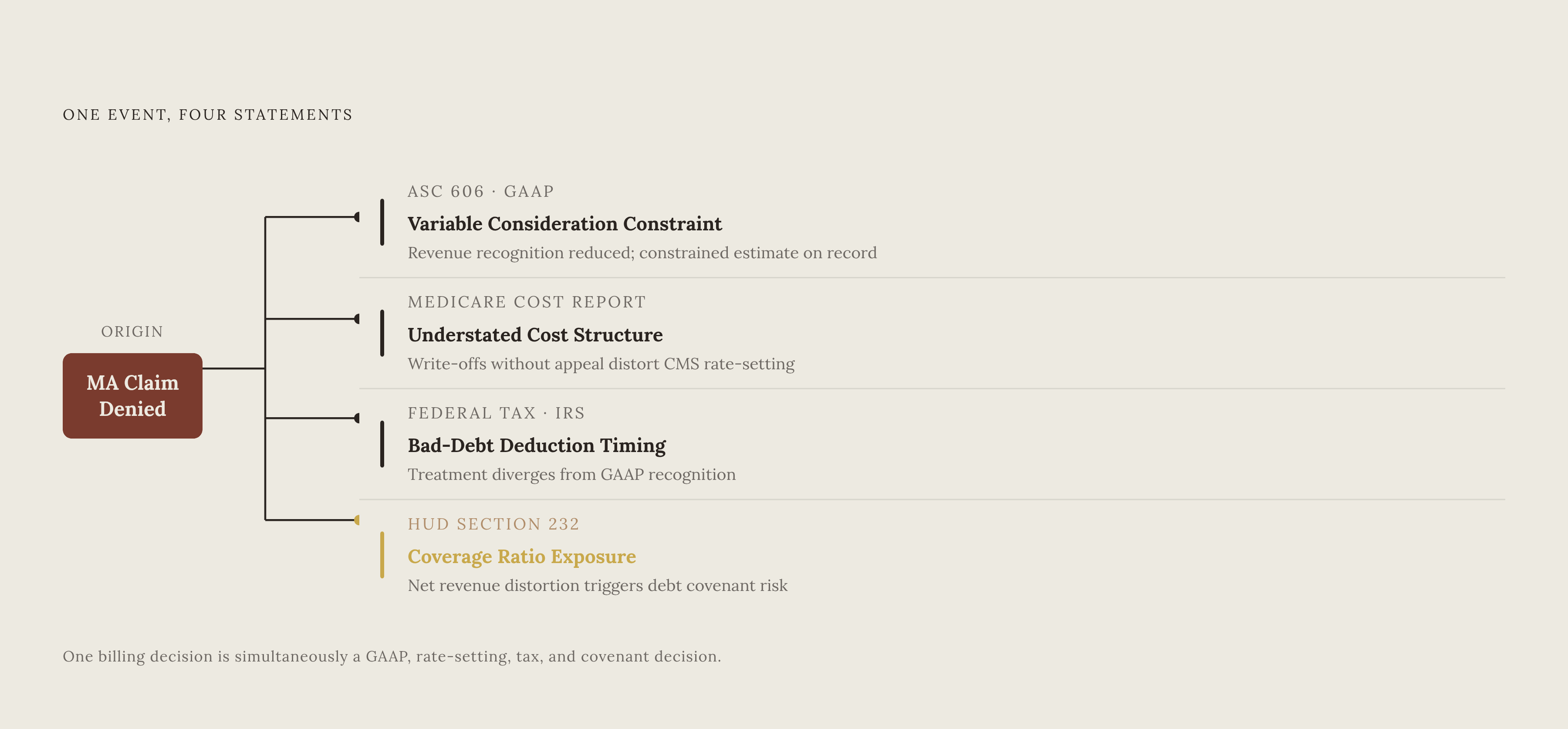
Layering a third statement on top of the two already discussed makes the reconciliation problem harder. GAAP financials follow the ASC 606 variable consideration constraint, where revenue is held back at recognition based on denial probability. The Medicare cost report follows CMS cost report instructions, and these may recognize or exclude MA revenue differently depending on how a given denial was categorized and whether it was appealed. The tax return follows IRS rules on bad debt deductions and income recognition, so depending on the accounting method the facility has elected, it can treat the write-off of an uncollected MA claim differently from how GAAP treats that same write-off. Three statements, three sets of rules, one underlying transaction.
Say it is deducted on the tax return but never properly excluded from the cost report, or constrained under GAAP but still recognized as revenue on the cost report. That inconsistency becomes an audit finding risk on any of the three surfaces, not just the one where the error originated. A tax examiner, a CMS cost report auditor, and a financial statement auditor could each flag the same underlying claim for a different reason, and none of them would necessarily know the other two had found it too.
There is a real planning opportunity buried inside this complexity. For pass-through owners, MA denial write-offs that reduce ordinary income create legitimate tax planning opportunities, but only when those write-offs are documented, timed, and kept consistent with how the same write-off is handled on the cost report. You need year-round coordination between whoever prepares the tax return and whoever prepares the cost report, not a scramble every filing season. Few operators examine the three-way reconciliation closely, but the ones who manage it well treat tax advisory and cost report preparation as one connected engagement, with people talking to each other across the year, rather than two filings produced in isolation and reconciled after the fact.
Denial-inflated cost reports and HUD Section 232 debt covenant exposure
For a SNF operator carrying HUD Section 232 debt, accurate revenue recognition is a covenant compliance question, not just a bookkeeping preference. Overstated net revenue, the kind that flows from unconstrained MA revenue recognition under GAAP, feeds directly into HUD's debt service coverage analysis and creates audit finding risk the moment it is caught. Understated net revenue, the kind that comes from denials absorbed without appeal, creates something worse than a finding: an actual coverage shortfall, measured against real debt service obligations that do not care how the shortfall happened.
The oversight structure meant to catch these distortions has had documented gaps. An OIG audit found that HUD's Office of Residential Care Facilities did not receive audited financial statements from all borrowers as required, did not ensure all borrowers fully developed action plans to address risks threatening a property's viability, and did not notify the Departmental Enforcement Center before some borrowers defaulted on their HUD-insured loans. None of this means HUD default is common, or that it follows automatically from a denial accounting error. It means the pathway from a mishandled denial, through an inflated or deflated cost report, into a covenant breach is shorter than most operators assume, and the oversight mechanism built to intercept that pathway has not always worked as intended.
That gap puts real weight on the financial statement audit itself. When MA denial revenue is not properly constrained under ASC 606, overstated net revenue flows straight into the audited financial statements HUD relies on for covenant monitoring. A thorough audit often catches this kind of distortion first, well before it reaches the point of a lender notification or a default conversation nobody saw coming. That is the practical argument for treating the audit as a genuine risk signal rather than a formality to clear once a year.
CMS oversight, the RADV audit environment, and SNF provider exposure
CMS signaled its intent to tighten Medicare Advantage oversight in a January 2026 memo: it plans to accelerate and expand RADV audits and to use AI to help human coding reviews move faster. The audit environment is tightening on the plan side, and by extension, on the provider documentation that those plans' claims ultimately rest on. CMS also confirmed the technology will only support certified human coders, not replace them, and that every coding decision capable of producing an overpayment determination still gets made by a human certified medical coder. If a documentation gap slips past an automated screen, the person reviewing it afterward can still catch it.
The picture gets more complicated on the plan side. A September 2025 court ruling vacated CMS's extrapolation method, pausing extrapolated recoveries while audits continue. The plan-side audit environment is genuinely in flux right now, which raises a question providers should sit with directly: does pressure on CMS from the plan side translate into less scrutiny of provider-level documentation? There is no reason to assume that. The two audit tracks, plan-level RADV and provider-level cost report and claim documentation, do not move in lockstep, and a pause on one does not imply a pause on the other.
There is also a structural tension: some denials do reflect genuine documentation gaps on the provider side, and the clinical dispute behind any given denial is a separate question from the accounting obligation that follows it, though not every denial reflects bad faith. But to the extent that MA plan denials are partly explained by plans managing their own risk score exposure under RADV, denying claims rather than generating documentation that might invite scrutiny, the denial pattern a SNF operator faces is partly a downstream effect of how plans manage their own audit risk, not purely a clinical utilization decision. A provider that absorbs those denials without appealing them is, in effect, helping the plan manage that risk at the provider's own expense. Layering onto that the new MS-DRG cost report data element described earlier creates a feedback loop: providers who have consistently absorbed denials will show cost reports with artificially low MA payment rates, and artificially low rates are exactly the kind of anomaly that draws rate-setting scrutiny or an audit request.
What getting both layers right requires in practice
None of the layers described above resolve through a single policy change or a one-time cleanup project. Getting the GAAP side right requires denial probability estimates built at the claim level or, at minimum, the payer-class level, with enough granularity to separate high-risk categories such as SNF post-acute transfers and complex wound care from routine, low-risk service lines. Those estimates need updating often enough to track how a specific plan's denial behavior shifts over time, not set once in January and left alone for twelve months. An algorithmic utilization review tool can worsen a denial pattern mid-year quickly, so when that happens, it needs to show up in the transaction price constraint before the next cost report cycle locks in the consequences.
Getting the cost report side right means you treat every write-off decision as a rate-setting decision with a delay attached, and you track appeal outcomes with enough discipline that overturned denials actually reverse through the constraint rather than vanishing into an undocumented adjustment. Getting the tax side right means the write-off timing and documentation line up with what the cost report shows, which requires the tax advisor and the cost report preparer to be talking across the year rather than reconciling after the fact. And for any operator carrying HUD Section 232 debt, all of this needs to appear correctly in the audited financial statements that HUD actually relies on, because that audit is the point where a denial accounting error either gets caught early or turns into a covenant problem nobody flagged in time.
What ties all four layers together is that none of them is a siloed function. A billing team managing denials, a tax preparer filing a return, and a cost report preparer filing with CMS are, whether they realize it or not, all recording the same underlying set of facts about the same claims. Treating those as three separate jobs, done independently and reconciled rarely or not at all, is how the inconsistencies described throughout this piece take root. Treating them as one connected body of work, reviewed together and checked against each other before each filing goes out, is what keeps a denial from quietly becoming a rate-setting problem, a tax exposure, and a covenant risk all at once.