Common Medicare Cost Report Errors That Trigger Reopenings
OIG audits reveal specific, preventable errors that repeatedly trigger cost report reopenings.

Medicare cost report reopenings follow a pattern, not chance.
Why Medicare cost report reopenings are not random events
Every Medicare-certified institutional provider, hospitals, skilled nursing facilities, home health agencies, hospices, FQHCs, RHCs, and ESRD facilities among them, has to file an annual cost report with its MAC. That report is what fixes final reimbursement for the period, and once a MAC settles it, the expectation is that the number is done. It isn't always done. When a settled report gets reopened, the reopening almost never traces back to a routine spot check. It traces back to something specific that was wrong and, in hindsight, correctable.
OIG's 2025 audit of NGS found that every one of the 60 reopened cost reports contained obvious errors or was inconsistent with Medicare requirements, a finding that points to a repeatable failure mode rather than random variance. A parallel audit of Novitas Solutions turned up the identical result across a larger sample, 118 reopened reports, all with the same kind of problem. Two different contractors, two different provider populations, and the same outcome each time. That is not statistical noise. That is a failure mode that repeats itself across the system.
So why hasn't CMS built a dashboard for this? It hasn't, because CMS has acknowledged it does not maintain centralized data on how many cost reports get reopened, what the resulting adjustments amount to, or what kinds of errors drive them. Providers can't lean on a federal tracking system that doesn't exist. The taxonomy of errors has to come from somewhere else, and this piece builds it from what OIG has actually found on the ground.
The dual financial exposure a reopening creates
A reopening cuts both ways, and that's the part providers tend to underestimate. Yes, it can mean the MAC finds an overpayment and demands money back. It can also mean the opposite: that the original filing understated what the provider was owed, and money that should have come back to the facility never did until the reopening corrected it.
Both audits, cited by the OIG, show this split concretely. NGS's 64 reopenings resulted in corrected settlements totaling millions of dollars, divided between amounts owed back to the program and amounts owed to providers. The Novitas reopenings landed in a similar place, with overpayments and underpayments appearing in roughly comparable magnitude. Neither side of that ledger is theoretical.
Then there's the lag. The gap between a cost reporting period's fiscal year end and the revised, reopened final settlement can run past three years. Three years is long enough for a provider to have already spent money it later has to return, or to have gone without money it was owed the whole time. For skilled nursing facilities in particular, the cost report isn't a side administrative task. It determines reimbursement, documents compliance, and shapes how CMS evaluates the facility going forward, which makes it central to financial stability and continued program participation.
The MAC review process and the conditions for reopenings
The mandatory desk review is the gate every cost report passes through, but that gate was never built for deep verification. It exists to flag issues that might justify a fuller audit, not to catch every mistake sitting in the filing.
OIG identifies the gap between what the desk review is supposed to catch and what it actually catches as structural, not incidental. NGS reported that its own auditors and supervisors needed more training on certain payment types, and that its supervisory review process failed to catch incorrect audit adjustments before they went out the door. The same weakness, inadequate supervisory detection, appeared across multiple contractors in the broader OIG series, including Novitas and Noridian Healthcare Solutions. This is a pattern across the MAC landscape, not one contractor having a bad year.
Errors can start on either side of the desk. Providers submit filings with omissions, miscalculations, misreporting, or duplicated entries, and MACs then miss those same errors during desk review, letting a flawed settlement stand until something forces a second look. OIG's work plan series on this issue, tracked under W-00-24-35886, still has at least one audit in progress. Scrutiny of MAC settlement practices hasn't wrapped up. It's ongoing. For a provider, the practical lesson is blunt: the desk review isn't going to save a bad filing. Getting it right before submission is the only control that actually belongs to the provider, and that's the thread the rest of this piece follows.
Documentation and reporting errors on Worksheet S-10 and bad debt schedules
Worksheet S-10 draws more audit attention than almost any other part of the cost report, and for a clear reason: it feeds directly into uncompensated care payments and DSH calculations, so MACs comb through it looking for weak or improper documentation of charity care and bad debt. Get S-10 wrong, and the error doesn't stay contained to one line item. It ripples into reimbursement categories that carry real dollar weight.
The documentation standard for Medicare bad debt is unforgiving in its specificity. A provider has to show, patient by patient, that the debt relates to a covered service, that a genuine collection attempt was made, that the patient was either determined indigent or the debt was otherwise uncollectible, and that the amount was formally written off the books.
What trips providers up most often is treating this as a summary exercise instead of a patient-level one. A general list of accounts that went uncollected does not meet the standard, no matter how accurate the total looks. Auditors want the underlying file for each patient, not an aggregate figure that assumes the detail exists somewhere. If that test fails for even a handful of accounts, the schedule has a real exposure sitting in it.
Misclassification errors in cost allocation, DSH calculations, and GME reporting
Misclassification is where cost reports break down structurally rather than through a single missed detail. Costs and salaries land in the wrong bucket with more regularity than almost any other error type: expenses posted to the wrong Medicare versus non-Medicare category, physician compensation classified incorrectly, and nursing or allied health program costs calculated in ways that don't match the underlying methodology.
DSH calculations sit in a category of their own. DSH calculations are explicitly identified by OIG as a high-risk audit area: the regulations are complex, the financial impact on reimbursements is significant, and the calculations frequently produce errors in either direction, underpayments or overpayments. It's not a category where a provider gets the benefit of the doubt just because a calculation looks reasonable on its face.
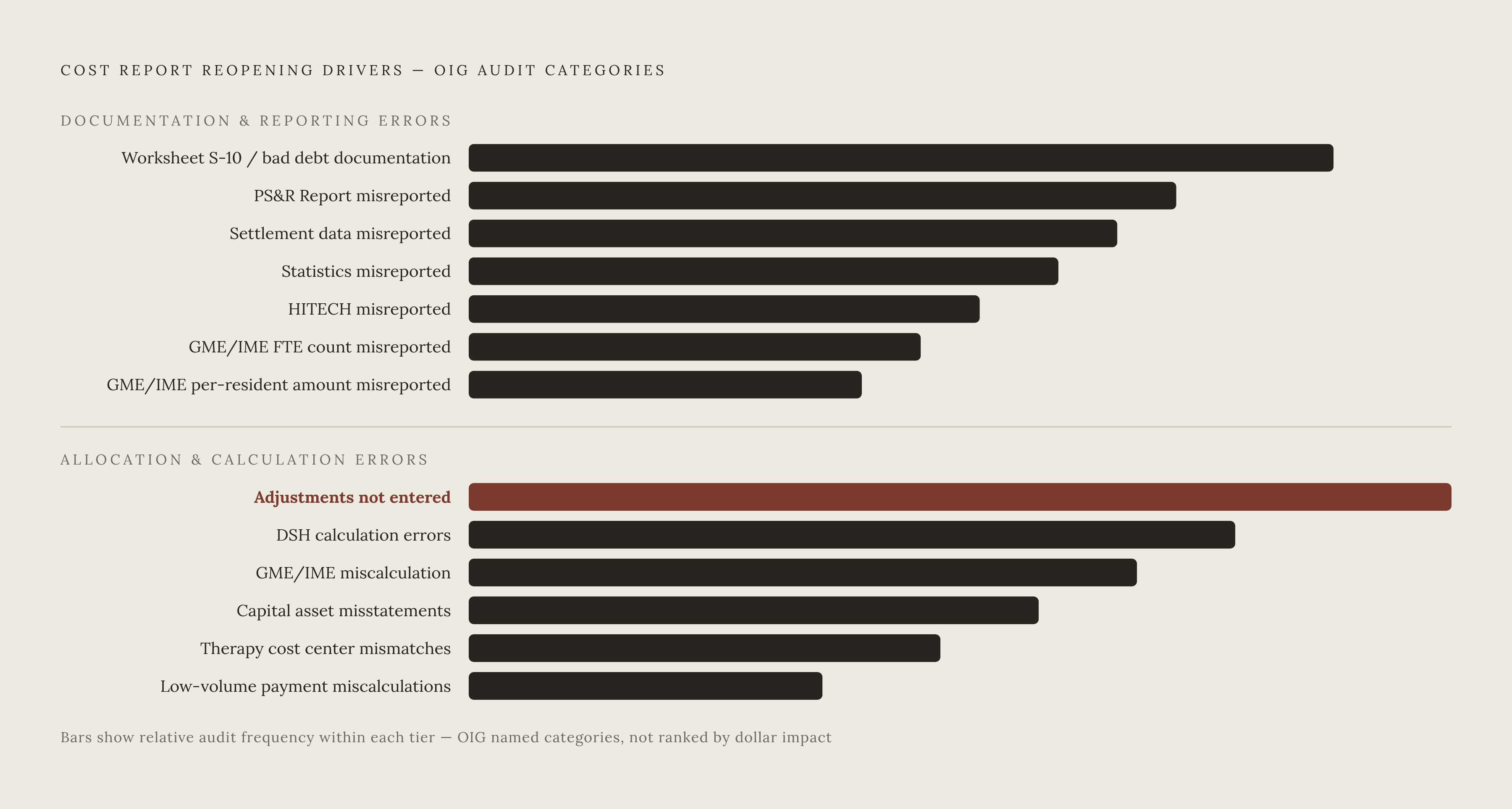
GME reporting recurs as its own distinct problem inside the NGS audit findings, and OIG provides granular detail on it. NGS's reopening categories separated out Graduate Medical Education per-resident amounts that were misreported, GME and IME full-time equivalent counts that were misreported, and a catchall GME/IME category that was miscalculated, each tracked as its own named error class rather than folded into a general bucket. Additional named error categories from NGS reopenings include settlement data misreported, Provider Statistical and Reimbursement (PS&R) Report misreported, statistics misreported, Health Information Technology for Economic and Clinical Health Act (HITECH) misreported, and adjustments not entered.
That last one, adjustments not entered, might be the most avoidable error on the whole list: an omission, something that should have been on the report and wasn't. For SNFs, allocation errors concentrate around sorting expenditures correctly between Medicare and non-Medicare categories, a trap frequent enough that most skilled nursing facilities now hand cost report preparation to professional preparers rather than attempt it in-house.
Capital asset misstatements, therapy cost center mismatches, and low-volume payment miscalculations
Misstating or misrecording depreciation or capital asset expenditures can both jeopardize reimbursement and trigger a more rigorous CMS audit, signaling to auditors that basic reconciliation between the general ledger and the cost report may not have been performed. That second consequence matters more than the first, in a sense, because it invites a harder look at everything else in the filing.
Therapy cost center mismatches follow a similar logic. Pairing the wrong expenses with the wrong revenues inside the Therapies cost centers is a documented reopening category, and it hits SNFs and rehabilitation providers hardest, since therapy services often make up a large share of their total cost structure. A mismatch there is a structural misstatement of how a major cost category actually behaves, not a rounding error.
Low-volume payment miscalculations round out the list, and they're notable because the MAC initiated the reopening in at least one documented OIG case, catching a payment calculation error that had left a provider meaningfully underpaid. That example cuts against the assumption that reopenings only ever go one direction, toward clawing money back. Sometimes the MAC is the one fixing an error that cost the provider money.
What links all three of these error types is the same missing piece: a clean, reconciled crosswalk between the general ledger and the specific worksheet lines on the cost report. Without that mapping in place, capital misstatements, therapy mismatches, and low-volume calculation errors are difficult to catch before the report goes out the door. The crosswalk is the audit trail that makes every other control in this piece actually functional.
The 2026 Medicare Advantage rate reporting requirement as a new error surface
The taxonomy above comes from historical audit findings, but the error surface is expanding. Starting with cost reporting periods ending on or after January 1, 2026, Medicare-certified acute care hospitals reimbursed under IPPS must report median negotiated payment rates from Medicare Advantage plans, broken out by MS-DRG, on their annual cost reports. This is new data, pulled from a new source, going onto a form hospitals have filed for years in a fundamentally different way.
The stakes attached to this new line item are not small. CMS intends to use the data to help set future MS-DRG relative weights, with that shift likely beginning in Fiscal Year 2029. It risks distorting a payment methodology years down the road, for every hospital in the system, not just the one that misreported.
What makes this requirement genuinely risky is that it demands data most hospitals have never had to gather this way before. This requirement introduces a new category of data that must be gathered from MA plan contracts, reconciled, and reported accurately, a process most hospitals have no established workflow for. That combination, a data source nobody has institutional experience collecting, feeding directly into long-term reimbursement policy, is precisely the profile of every high-error category already covered in this piece. Hospitals that build the same discipline into MA rate reporting that careful providers already apply to S-10 and bad debt documentation are the ones likely to avoid becoming the next OIG case study.
Internal control failures in HUD Section 232 and related compliance contexts
For skilled nursing facilities that also carry HUD Section 232 insured debt, the exposure doesn't stop at the Medicare cost report. Two regulatory regimes, running in parallel, both watching the same underlying financial records.
Providers that are both Medicare-certified SNFs and HUD Section 232 borrowers face a second layer of assurance running simultaneously, since HUD engagements run on strict deadlines, follow a specific electronic format, and are governed by the HUD Consolidated Audit Guide and Government Auditing Standards, and the most frequent finding in initial audits is a bookkeeping placement error: HUD escrow accounts, replacement reserves, property tax escrows, insurance escrows, recorded on the operating company's books when they belong on the borrower's books instead. That's a classification mistake, structurally similar to the Medicare misclassification errors already discussed, just sitting in a different regulatory framework. The updated Section 232 Handbook takes effect January 5, 2026, and applies to all new loan applications and transactional requests on existing Section 232 projects, so this isn't a static rulebook providers can file away and forget.
The connection between these two compliance worlds runs deeper than surface resemblance. Weak internal controls, thin supervisory review, and general ledger accounts that never get reconciled produce Medicare cost report errors, and those exact same conditions produce HUD reclassification findings. One weak set of controls generates two separate compliance failures, in two separate audits, because the same governance failures, weak internal controls, insufficient supervisory review, and unreconciled general ledger accounts, produce both the Medicare cost report errors and the HUD reclassification findings. A cost report error that triggers an overpayment demand reduces cash flow, and reduced cash flow can breach debt service coverage covenants on HUD-insured debt, potentially triggering a reportable event under the lender agreement. A misclassified physician salary on a Medicare cost report can, through that chain, become a mortgage banking compliance problem months later.
What providers can control before submitting the cost report
Everything traced through this piece points back to a small number of concrete practices, and the first is the crosswalk already mentioned in the capital asset section: a reconciled working trial balance that maps every general ledger account to the exact cost report worksheet line it feeds. That single document is what catches misclassification, capital misstatement, and therapy cost center errors while there's still time to fix them.
Deadlines matter as much as accuracy does. Cost reports are due on or before the last day of the fifth month following the close of the fiscal year, May 31 for a provider on a calendar year, and missing that date can suspend Medicare payments, forfeit bad debt reimbursement for the entire year, and raise the odds of a closer audit later. Filing through the MCReF electronic system rather than on paper gives providers validation checks and submission confirmation that a paper filing simply doesn't offer.
Bad debt documentation shouldn't be a scramble in the weeks before filing. It should be built continuously across the year, patient by patient, since the patient-level detail requirement is the single most commonly failed standard when these schedules get audited.
For providers who rely on third-party billing or cost report preparation vendors, a SOC 1 report on that vendor's internal controls isn't a paperwork formality. It speaks directly to whether the numbers the vendor hands back are the numbers that belong on the filing. And related-party transactions, particularly a lease between a closely held operator and an affiliated real estate entity, draw scrutiny whenever the rate charged exceeds what an arm's-length deal would produce. Providers should document the basis for those terms before the report goes out, not after a MAC asks the question. Professional cost report preparers have become common among SNFs for a reason: the allocation and documentation demands covered throughout this piece are dense enough that most operators find it more reliable to bring in someone who works inside this taxonomy every filing season.
Sources
- OIG.HHS.GOV August 2025 | A-06-24-05004 National Government Services, Inc.,
- Medicare Administrative Contractor Cost Report Settlements with Audit | Office of Inspector General | Government Oversight | U.S. Department of Health and Human Services
- Contract Year 2026 Policy and Technical Changes to the Medicare Advantage Program, Medicare Prescription Drug Benefit Program, Medicare Cost Plan Program, and Programs of All-Inclusive Care for the Elderly (CMS-4208-F) | CMS
- national government services inc reopened and corrected cost report final settlements for desk reviews only with obvious errors to correct payments made to medicare providers
- novitas solutions inc reopened and corrected cost report final settlements for desk reviews only with obvious errors to correct payments made to medicare providers
- Department of Health and Human Services Office of Inspector General