Unclaimed Property Compliance for Healthcare Operators
Healthcare operators must trace complex billing credits to determine what they actually owe.

Unclaimed property compliance for healthcare operators begins with a question that a generic checklist cannot answer, namely whether an unresolved balance is legally owed to someone. Multi-party billing, state rules and acquired liabilities make that determination unusually difficult. Healthcare operators therefore need a clear compliance process built for their industry to find what they owe and challenge assessments that treat accounting balances as reportable property.
Why healthcare operators face a different unclaimed property problem than other industries
In many industries, unclaimed property starts with a relatively straightforward obligation, such as a payroll check or vendor payment that remains uncashed. Healthcare operators hold those items too, but their billing systems make it harder to tell what they owe. A single encounter can involve a patient, a primary insurer, a secondary insurer, a government payer and the provider. Each party can create a credit balance on its own. Determining what the provider owes therefore requires more than finding an old entry in the ledger.
The underlying duty is familiar even when the accounting is not. When a refund goes uncashed or its owner cannot be located, the holder must make documented outreach attempts and ultimately turn the funds over to the state through escheatment. Healthcare organizations are not exempt from that process. Yet complex business agreements, updated and accounted for on a rolling basis, can make it difficult to establish whether property exists to report in the first place. This threshold question makes the complexity structural rather than incidental, because compliance depends on understanding the transaction before applying the reporting rule.
The specific billing dynamics that generate unclaimed property in healthcare
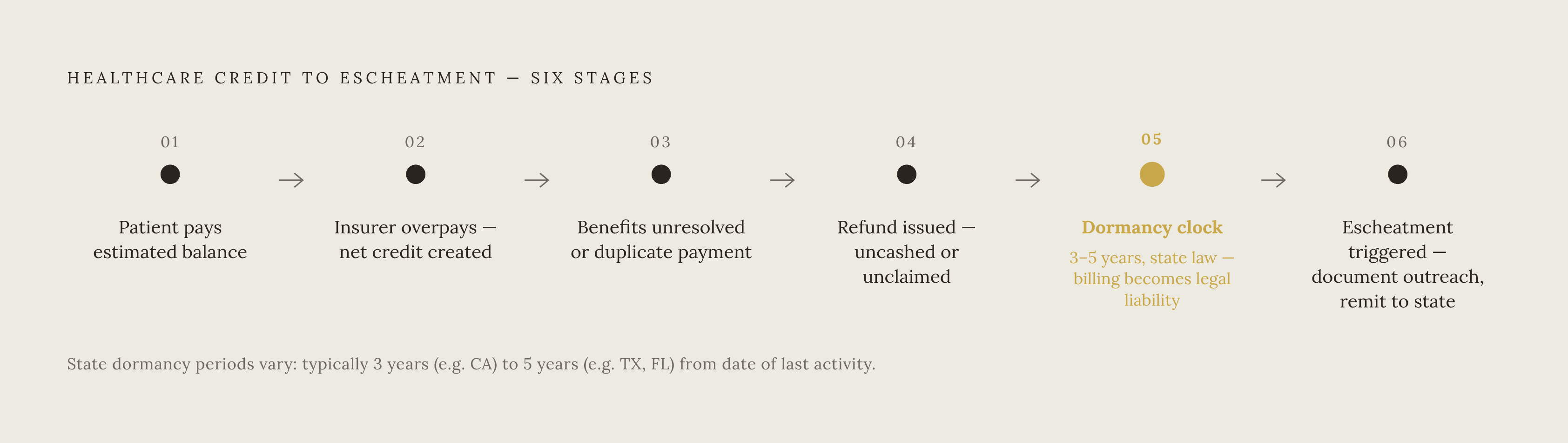
A credit balance can arise even when everyone involved does everything right. A patient pays an estimated balance, and insurance later pays more than expected, leaving a net credit. Alternatively, the patient and an insurer, or two insurers, pay the same bill before coordination of benefits is resolved. A refund may then be issued but never negotiated by its recipient. As the unresolved credit or uncashed check ages, dormancy rules can turn a routine billing matter into an unclaimed property obligation.
That sequence is different from the periodic reconciliation needed for vendor payables, payroll checks and accounts payable credits. Patient and insurance credits require an analysis of the underlying payment rights. Providers and insurers use settlement audits from time to time to clear up open items, after which a provider may adjust or write off accounts receivable balances. Anti-limitation provisions in most state unclaimed property statutes mean that a write-off does not extinguish the duty to report or remit.
Prompt pay statutes and recoupment rules make that distinction harder to resolve. Most states give insurers a defined window to process claims, while many also limit how long insurers can claw back paid claims. Those timelines interact with, and sometimes conflict with, unclaimed property dormancy periods. The careful inquiry is therefore not just how long a balance has remained open, but what payment rights survive. An auditor who overlooks those rules can substantially overstate the amount owed.
Why state unclaimed property rules compound the complexity for multi-site operators
Once the underlying obligation is understood, a multi-site operator still has to determine how state law treats it. Some states require a report after three years of inactivity, while others allow five. There is no single national rule, and within each state, the dormancy clocks may differ by property type. Reporting rules and enforcement approaches also vary. A process that works for one facility cannot simply be copied across a health system without accounting for those differences.
Business-to-business exemptions offer a possible defense for certain payor-to-provider payments, but their scope varies widely. When an exemption is read narrowly, it is unsafe to use it as grounds to leave insurance credits out of reports across the board. Federal preemption raises a separate question because Medicare and other federal programs govern payment rights, claim obligations and limitation periods. Those federal rules can preempt a state's demand for at least some funds that an audit identifies. Both defenses need a close legal review before a holder can rely on them to avoid a compliance duty.
States are also encouraging holders to address gaps before an audit begins. The California State Controller's Office waives its annual interest assessment for proactive reporters through its Voluntary Compliance Program. Its initial reminder mailings went to roughly 4,000 companies, with follow-up letters sent in early 2026. That outreach shows that enforcement includes both recruiting voluntary compliance and examining past failures.
How M&A activity turns historical unclaimed property into a current liability
Healthcare mergers and acquisitions bring old balances into a new owner's present-day responsibilities. The large number of transactions and the role of private equity have made healthcare a top target for multistate unclaimed property audit campaigns. Transactions draw attention to a target's books, including dormant balances accumulated over years. The resulting exposure may have little connection to decisions made by current management.
The lookback period makes that inheritance especially important. States are willing to examine many years of records, so an acquired entity may carry exposure that substantially predates its current ownership. Yet buyers frequently do not assess unclaimed property with the rigor applied to tax or litigation contingencies. When buyers fail to assess unclaimed property fully, the liability becomes a current financial problem after closing. M&A therefore acts both as an audit trigger and as a means of transferring obligations that the buyer did not fully understand.
Mission Point Health Care shows what is at stake when financial liabilities pile up, though no unclaimed property failure has been established in this case. After the chain collapsed under massive debt, unpaid taxes and serious federal penalties, its operating businesses were sold for a nominal sum plus the assumption of millions in liabilities. The sale excluded the real estate and went to an investment group tied to Villa, another nursing home chain. The distinction matters because this example does not establish an unclaimed property connection. Its relevance is narrower, showing how unresolved obligations can become central to the terms of a healthcare transaction.
Why the standard unclaimed property audit methodology produces unreliable results when applied to healthcare
Standard unclaimed property audit methods tend to look at one holder and ask for documents in ways designed for businesses whose transactions are more alike. Healthcare records, however, reflect HIPAA, prompt pay statutes and government payer rules. Generic requests can impose expectations that do not align with those legal requirements or industry practices. Providers and advisors may consequently spend substantial time explaining the billing framework before the substantive audit can proceed. The mismatch affects the evidence used to calculate liability.
Requests that are excessive in time or scope can lead to sampling and extrapolation. If the sample treats unresolved credits as established obligations without considering payment law, extrapolation magnifies the mistake. An auditor may object that property must exist because the provider kept the money. But federal preemption, recoupment limitations and prompt pay rules may defeat a claim that a ledger balance must be remitted. The existence of an accounting credit is evidence to examine.
Complexity nevertheless does not prevent regulators from reconstructing financial flows. The New Jersey Office of the State Comptroller found that Hagler and Rozenberg inflated rent payments from the Hammonton and Deptford Centers to their property companies and diverted tens of millions in Medicaid funding. Centers admitted in a related federal settlement dated June 17, 2025, that it made false statements, including material omissions, by failing to list related parties on cost reports for 44 nursing homes across New York, Rhode Island, Kansas, and Missouri, though these findings are not unclaimed property determinations.
How enforcement escalates from a state audit into False Claims Act territory
An overstated assessment is one risk, but failing to address a valid obligation creates another. A continued failure to remit can lead to False Claims Act exposure on top of administrative compliance duties. California's action against U.S. HealthWorks demonstrates that escalation. The California attorney general's complaint in intervention alleged that the company knowingly kept millions of dollars in unclaimed overpayment balances, unclaimed refund checks and other property in violation of the Unclaimed Property Law and the California False Claims Act. The matter resulted in a multi-million-dollar settlement.
Unclaimed property failures can become the basis for a false claims action. New York and other states also use their own False Claims Act mechanisms to enforce unclaimed property laws. Separately, penalties and interest can accumulate over long periods, with states assessing interest on balances going back more than a decade. The resulting exposure can dwarf the cost of proactive compliance.
This is the point at which the issue becomes a governance concern. Both the corporate entity and decision-makers who knew of an obligation but failed to act can face False Claims Act exposure. The question for leadership is consequently broader than whether the billing department clears old accounts. It includes whether known obligations receive an adequate response and whether unresolved legal questions are actually resolved.
What a structured compliance approach looks like in practice
A healthcare-appropriate program starts with a two-track inventory. General ledger items, including vendor payables, payroll checks and accounts payable credits, need to be reconciled from time to time. Patient and insurance credits need their own process based on account aging and the rules for each payer. A review of vendor accounts and check registers shows which open checks and credits need to be reconciled.
The next step is to connect that inventory to clear refund and overpayment handling rules. The fraud, waste, and abuse policy should explicitly address those processes in accordance with state law. An overpayment log should record the relevant dates so that dormancy deadlines can be tracked by property type and state. Current patient and vendor addresses also need routine attention because documented outreach cannot depend on stale contact information. These elements turn a collection of balances into obligations that can be followed through resolution.
Health plan contracts should be examined for coordination of benefits and payment obligations before exemptions are applied. Staff also need specific training in both False Claims Act obligations and unclaimed property law, rather than relying on general billing compliance training. For multi-site operators, the program must track each state's dormancy periods, which payments its business-to-business exemptions cover and whether it offers voluntary disclosure. Where gaps are identified before an audit, voluntary disclosure programs available in many states can substantially reduce exposure.
Where unclaimed property compliance intersects with the broader financial audit picture for healthcare operators
Unclaimed property is also a financial statement risk, which places it within the broader discipline of financial reporting. Healthcare borrowers with HUD Section 232 federally insured mortgages must submit audited annual financial statements that comply with HUD's Uniform Financial Reporting Standards under 24 CFR 5.801 and 24 CFR 200.36. The borrower bears that annual audited reporting duty. Operators submit quarterly statements that may be operator-certified.
HUD OIG's audit issued April 2, 2026, found that ORCF had not always acted on financial risks already disclosed in borrowers' audited statements. Those risks included withdrawals when no surplus cash was available, cash deficiencies and insufficient cash flow to service debt. The findings show the limits of relying on regulatory review to prompt action. HUD ORCF's staffing also declined sharply between October 2024 and May 2025. Operators cannot outsource vigilance to an under-resourced regulatory backstop.
For skilled nursing and assisted living businesses, audited financial statements are a governance record that regulators, lenders and HUD rely on. Unidentified or undisclosed unclaimed property liabilities weaken that record. An advisory relationship combining healthcare-specific audit knowledge with unclaimed property expertise can bring these risks into view before they become findings or enforcement actions. That combination is the structural answer to the problem, joining knowledge of billing rights, state obligations and financial reporting in one compliance approach.