State Survey Deficiency Impact on Medicaid Reimbursement Rates
Deficiencies cut Medicaid and Medicare revenue through three distinct payment mechanisms.

State survey deficiencies can erode a skilled nursing facility’s Medicaid reimbursement through specific payment rules. They can also affect Medicare revenue, balance-sheet liabilities and mortgage financing. Understanding that chain allows SNF leadership to treat survey performance as a financial variable and manage the exposure before it becomes lost revenue.
Why survey deficiencies are a bigger financial problem than most SNF leaders treat them as
SNF leaders routinely manage deficiencies as a regulatory and operational problem. That view keeps the focus on correcting findings, but it can leave the finance team unaware of the payments at risk until money is already lost. A corrective response and a financial assessment answer different questions. The former addresses what must change in the facility, while the latter identifies which payments or liabilities the finding puts at risk.
The distinction matters because a deficiency does not have one uniform financial consequence. Its effect depends on the payment methodology, the facility’s eligibility for incentives and the enforcement response. A finding that affects a quality benchmark can reduce earned reimbursement, while a finding that triggers a penalty creates a separate expense. Treating both as an undifferentiated compliance cost obscures the rules that make those losses calculable.
The three channels through which deficiencies reduce what a facility actually gets paid
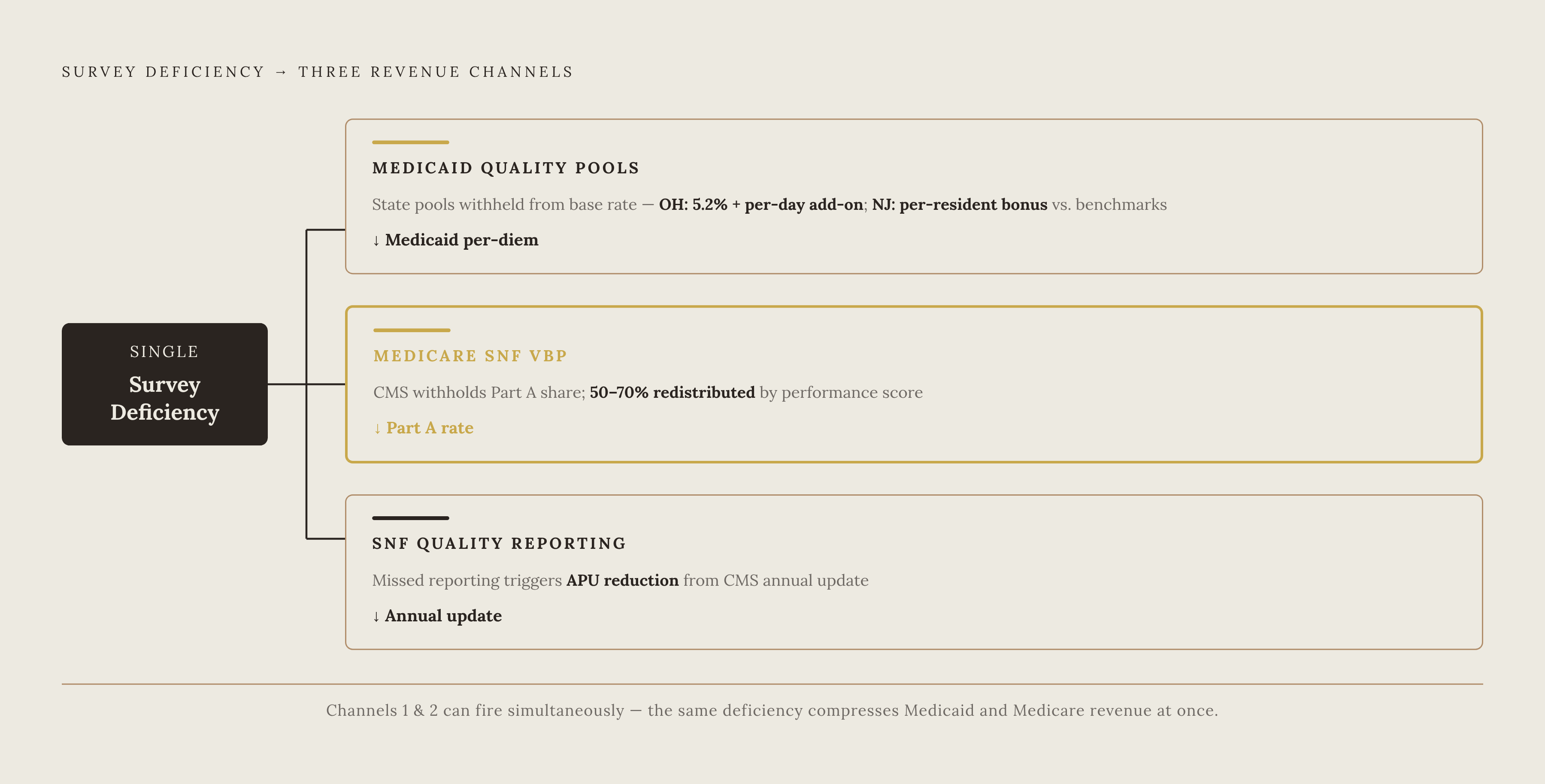
The first channel is the state Medicaid quality incentive pool. States place a portion of the per-diem Medicaid rate into a pool that facilities must earn back by meeting benchmarks drawn from CMS quality metrics informed by survey results. The facility must therefore determine how much of the published payment it remains eligible to earn.
Ohio Revised Code § 5165.26, effective March 20, 2026, spells out who can receive the payment. A facility placed on the Special Focus Facility list and listed in table A is ineligible to receive its quality incentive payment. The pool represents five and two-tenths percent of base rate plus a fixed per-day add-on plus sixty per cent of the per diem amount by which the facility’s cost per case-mix unit changed as a result of rebasing. The Ohio Supreme Court in 2025 ruled unanimously in favor of nursing home associations, forcing the Ohio Department of Medicaid to recalculate quality incentive payments it had under-distributed. That ruling establishes that the accounting behind these pools is legally enforceable.
New Jersey’s Quality Incentive Payment Program (QIPP) illustrates the same financial logic through benchmark achievement. Facilities earn per-resident-per-day payments above their normal Medicaid rate based on how many quality benchmarks they meet. Deficiency-driven deterioration in those metrics therefore reduces the bonus directly. Unlike Ohio’s stated exclusion, this mechanism ties the amount earned to the benchmarks met.
The second channel extends the exposure to Medicare. CMS withholds a portion of SNFs’ Medicare fee-for-service Part A payments to fund the SNF VBP Program, then redistributes between half and seventy percent of that withhold as incentive payments based on performance scores. Deficiencies that depress the quality measures used for scoring can reduce the facility’s incentive payment. The same underlying quality weakness can consequently compress Medicaid and Medicare revenue, though each program applies its own payment rules.
The third channel is a reporting condition. CMS describes the SNF Quality Reporting Program as a pay-for-reporting program, under which facilities that fail to meet reporting requirements face a reduction in their Annual Payment Update. A survey deficiency is not, by itself, the reporting failure that triggers this reduction.
How Civil Money Penalties translate deficiencies into balance-sheet liabilities
Civil Money Penalties add an expense on top of the risk of lower reimbursement. Significant deficiencies can erode net income and generate contingent liabilities requiring financial statement assessment and disclosure. The facility must assess how much revenue it can earn and how much enforcement exposure belongs in its accounts.
The FY 2025 SNF PPS final rule expanded that exposure. The rule was effective October 1, 2024, with CMP enforcement provisions specifically effective October 5, 2024, and CMP requirements operationalized beginning March 3, 2025. CMS can now impose multiple per-instance penalties from a single survey and impose per-day and per-instance penalties simultaneously. It can also apply penalties over a look-back period covering the last three standard surveys. Consequently, reviewing only a current finding or a single assessed penalty can leave part of the exposure unexplored.
A peer-reviewed study in Innovation in Aging found that CMP penalties are associated with statistically significant reductions in net income margins. CMS acknowledges that the SNF cost report is self-reported and unaudited by CMS. Independent financial statement audits therefore carry an important responsibility to assess CMP liabilities accurately, including contingent and unreported exposures management may not have fully quantified.
Why the deficiency-to-reimbursement chain is getting harder to escape, not easier
Deficiency risk and payment pressure are tightening at the same time. KFF’s 2025 analysis documents a sustained increase in average deficiencies per survey cycle over the past decade and finds that 27% of facilities carry serious deficiencies for actual harm or jeopardy. Abt Associates’ 2023 report identifies understaffing as a structural driver. These findings place the reimbursement problem within an operating environment where the conditions behind deficiencies cannot be separated neatly from financial performance.
Survey capacity adds uncertainty to that relationship. As of December 2025, a large share of nursing homes had not been surveyed within the required fifteen-month window. CMS’s FY 2026 budget request acknowledged that it lacked resources to complete all required inspections. The deficiency record used in quality-payment formulas is thus becoming more uneven and harder to predict. A delayed survey does not establish that a facility has less underlying financial exposure.
At the same time, the room to absorb payment losses is narrowing. KFF’s 2025 Medicaid budget survey documents an uptick in states imposing provider rate restrictions in FY 2025 and FY 2026, compared with 1 state reporting rate decreases in FY 2024 and 2 states in FY 2023. MedPAC’s March 2026 report recommends that Congress cut the 2026 Medicare base payment rates for SNFs by four percent for fiscal year 2027. That recommendation identifies another potential source of margin pressure. If enacted, it would leave facilities less room to absorb the quality-payment losses described above.
How state payment model transitions change the exposure for facilities with deficiency histories
State payment reform can change the methodology within which a deficiency history has financial consequences. North Carolina’s Department of Health and Human Services asked for approval to move its SNF program from the Resource Utilization Group (RUG) version IV model to the Patient-Driven Payment Model (PDPM) rate structure. That request concerns the components used to set rates. It thus raises a question about how the facility’s current performance would fit the changed payment model.
The North Carolina request establishes the proposed transition, but the supplied material does not quantify a deficiency-related rate adjustment. It would be too broad to treat the change as proof of a uniform penalty for every facility with a deficiency history. The payments at risk depend on how the state’s methodology brings patient-driven payment components and quality-related rules together. Facilities with persistent deficiencies are poorly positioned where those rules give financial weight to quality performance.
Maine’s 2025 rate reform provides a more explicit quality-payment example. Maine restructured its nursing facility reimbursement methodology to include a quality bonus pool that in Year 1 rewards participation in quality improvement activities tied to staff turnover, resident and family satisfaction, and antipsychotic medication use. Outcome-based performance awards phase in from 2026. Those outcomes correlate inversely with deficiency rates, linking the reform to the operating weaknesses already reflected in survey histories. Together, these state changes indicate a direction of travel.
What the deficiency-reimbursement chain means for HUD Section 232 financing
For facilities financed under HUD Section 232, survey history also enters mortgage underwriting. Deficiencies can affect access to and the cost of federally insured mortgage capital because their consequences extend to the operator’s financial condition. Lost reimbursement and the risk of penalties also become part of the financial risk weighed when financing the property.
HUD OIG’s 2026 audit, Report 2026-BO-0001, April 2, 2026, found that HUD’s Office of Residential Care Facilities is not promptly mitigating financial risks reported in audited financial statements for Section 232 residential care facility portfolios. The finding shows why financial risks need a prompt response once they are found. Audit quality and timely reporting have direct credit-risk consequences in this setting.
A multifamily investor who acquires the real estate but leases it to a weak operator can encounter the operator’s deficiency record in underwriting. Survey history is thus a mortgage underwriting variable as well as a regulatory record.
How SNF financial statement audits must account for deficiency-driven exposures
A financial statement audit must follow the chain from survey findings to their accounting consequences. They include contingent liabilities, questions about revenue recognition and signs of going-concern risk. The task is to determine which rules apply and whether the statements reflect the resulting financial position.
CMP assessment must address undisclosed or under-quantified liabilities, including exposure within the expanded look-back period covering the last three standard surveys. For revenue recognition, the auditor must separately assess quality incentive payments that could be lost because of Special Focus Facility status or benchmark shortfalls. Ohio’s defined payment pool shows how much eligibility can affect the amount recognized. Where combined penalties and quality-payment losses compress operating margins toward structural insolvency, the audit must also assess going-concern implications.
For HUD Section 232 facilities, that work extends to covenant compliance and timely financial reporting. The regulator’s lack of independent verification of the self-reported cost report also makes accurate, documented financial information especially important. An auditor needs to understand how survey results, Medicaid cost reports, quality pools and CMP accounting work together. SNF-specific regulatory and reimbursement knowledge is therefore a substantive audit capability.
Practical steps SNF leadership can take to interrupt the deficiency-to-reimbursement chain
Leadership can start with staffing as a reimbursement-protection decision. KFF’s 2025 analysis cites Abt Associates’ finding that better-staffed nursing homes are typically cited for fewer deficiencies. The financial case for adequate staffing should therefore connect the investment to the payment exposure that deficiencies create.
Finance teams should also track quality metrics as a financial ledger. Modeling how many dollars would be at risk under Special Focus Facility designation or benchmark-shortfall scenarios shows what the facility could lose before it loses eligibility. The same prospective approach belongs in CMP planning. Facilities should work with their accountants to quantify and reserve for potential liability, as appropriate, across the last three standard surveys rather than wait for enforcement to make the amount unavoidable.
Leadership can also take care to prepare an accurate, well-documented cost report. Investing in that preparation reduces the risk of adverse rate adjustments and audit adjustments that expose reimbursement errors. Leadership should also track state plan amendment filings and model how changes in methodology would affect the facility given its own deficiency profile. North Carolina’s proposed PDPM transition shows why that work concerns the structure of future rates.
These steps require leaders to bring what they know about operations into financial decisions throughout the year. Survey findings, incentive eligibility, penalty exposure and rate reform do not arrive on the audit calendar. The facilities best positioned to manage the chain treat their accountant as a year-round advisor.