Why LTC CFOs Stop Trusting a SOC 2 Report That Cannot Answer Questions About Skilled Nursing Workflow Controls
A SOC 2 proves data security, but only a SOC 1 covers billing accuracy.

SOC 1 and SOC 2 examinations build trust when they answer the buyer’s actual risk questions. For an LTC CFO evaluating a skilled nursing billing or EHR vendor, SOC 2 does not establish assurance over financial-reporting controls. That requires a SOC 1 with control objectives tied to the workflows that determine billing accuracy and revenue cycle integrity.
Why a SOC 2 report is built for a different audience than an LTC CFO
A SOC 2 report is an independent CPA attestation against the AICPA Trust Services Criteria. Its five categories are Security, Availability, Processing Integrity, Confidentiality, and Privacy. Security is mandatory. The service organization chooses which other categories to include. The report answers the questions IT security teams and vendor risk managers ask about how a service organization protects information and runs its systems. Its scope is not automatically comprehensive.
A Type 1 assesses whether controls are suitably designed at a point in time, while a Type 2 evaluates whether they operated effectively over a defined period. Both use the same Trust Services Criteria, which are fixed. The service organization designs its controls to meet those criteria, but it cannot replace them with its own domain-specific objectives.
This gives buyers assurance about data protection, security maturity, and the other categories the report includes. It also explains why a report can be useful to an IT team without answering a finance team’s questions. The audience determines the question being asked. A longer examination period does not turn assurance against the Trust Services Criteria into assurance over a customer’s financial reporting.
What an LTC CFO actually needs to know about a billing or EHR vendor
An LTC CFO evaluating a billing or EHR vendor needs to understand how the vendor’s controls affect recorded revenue. Are PDPM payment calculations complete and accurate? Is MDS data submitted with integrity, and do Medicare and Medicaid claims reconcile correctly? These questions trace how transactions flow into the facility’s financial statements. They are not simply questions about IT procurement.
The financial exposure gives those questions urgency. MedPAC’s March 2025 report to Congress put the all-payer total margin for skilled nursing facilities at just 0.4 percent in 2023, following losses in 2022. Billing errors that keep happening hurt an already fragile bottom line. The same report says that doubts about the accuracy of provider-reported function data limit which SNF quality measures can be used. That finding shows why data accuracy is a practical concern.
For the CFO, the decisive issue is whether controls over the vendor’s transaction flows were designed and operating correctly. Patient billing, revenue cycle management, and claims processing can all affect the accuracy and dependability of financial statements. When revenue comes from a third-party system, the CFO’s year-end judgment rests in part on how work is done outside the facility. Evidence that information is protected answers one concern about that relationship.
Why SOC 2 Processing Integrity controls do not fill the gap, even when scoped in
If a SOC 2 addresses completeness and accuracy of processing, why would it not answer questions about billing accuracy? Processing Integrity uses five criteria, PI1.1–PI1.5, written for service organizations in many industries, with no specific focus on skilled nursing financial reporting.
PI1.1 requires documentation of inputs, processing logic, outputs, and product and service specifications for each in-scope process. Across the category, the concern is generic completeness and accuracy of system processing. Those requirements can be relevant to healthcare billing and claims processing. They do not, however, replace the fixed criteria with objectives expressly addressing PDPM calculation logic, MDS submission rules, or Medicare cost report support. Documenting what a system processes is not the same as defining the financial-reporting objectives against which its controls will be examined.
Scope still makes a meaningful difference here. A carefully scoped SOC 2 Type 2 that includes Processing Integrity provides more relevant evidence about processing than one that excludes it. The limitation is not that billing processes must be absent from the report, or that the controls examined have no value. It is that supplemental detail in the system description does not change the basis of the auditor’s evaluation. A CFO seeking precise financial-reporting assurance still needs an examination organized around those objectives.
How a SOC 1 examination is structurally different and why that difference matters here
A SOC 1 examination looks first at internal controls over financial reporting. Service organization management writes control objectives describing what the service does and what could go wrong in ways that affect customers’ financial statements. The auditor evaluates whether those objectives are reasonable for the service and relevant to customers’ financial reporting. The AICPA allows flexibility in the objectives so the examination can address the financial role of a particular service.
For an SNF billing vendor, objectives could address PDPM rate calculation completeness, MDS data transmission accuracy, claims submission and reconciliation, and Medicare/Medicaid remittance posting. Each objective would identify a financial-reporting concern rather than leave the reader to infer it from a general description of processing. Specificity is the useful difference. Merely attaching the SOC 1 label to broad objectives would not give the CFO the same precision.
The Type 1 and Type 2 distinction still applies. A SOC 1 Type 1 assesses the design of controls against those objectives at a point in time, while a Type 2 assesses their operating effectiveness over a defined period. The facility’s financial statement auditor can rely on a SOC 1 Type 2 when scoping the audit of revenue. A SOC 2 provides no equivalent basis for that reliance. The practical question for the CFO is therefore not which report ranks higher, but whether the vendor’s objectives address the financial workflows the facility depends on.
Where the confusion originates and how vendors exploit it unintentionally
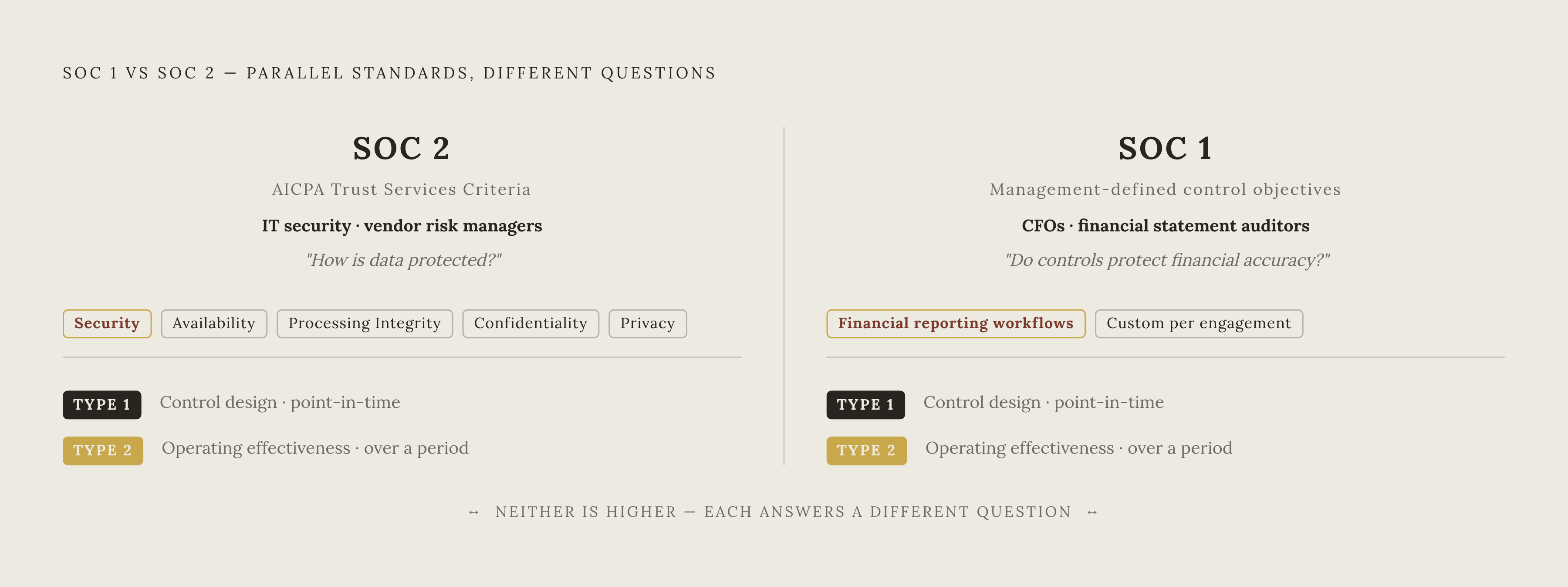
The numbers make the two examinations look like steps up the same ladder. SOC 1 and SOC 2 examine different things under different standards. Yet a buyer unfamiliar with those distinctions can reasonably assume that the higher number represents broader assurance. That belief can lead buyers to trust a report for more than it was designed to do.
The sales process reinforces the misunderstanding. SOC 2 has become a default credential in technology sales because IT security teams recognize it and often dominate vendor evaluation. A vendor that pays for the report those buyers ask for may have little reason to bring up the need for financial-reporting assurance. Its sales team may not volunteer the distinction. The gap can remain hidden until the customer’s financial statement auditor asks a different set of questions.
This is an information mismatch. A SaaS company’s SOC 2 can support enterprise sales by addressing the security concerns that would otherwise impede the buyer’s evaluation. Settling an IT objection does not make the report able to settle a finance objection. Some LTC vendors do need both reports, including claims processors and third-party administrators that handle paid claims and reserves while also processing protected health information. For those services, trust depends on matching each report to the concern it can answer.
How HUD 232 financing requirements make the gap a compliance liability, not just an audit preference
HUD Section 232 connects this distinction to mortgage compliance. The program provides mortgage insurance for residential care facilities, including nursing homes, assisted living facilities, board and care homes, and intermediate care facilities. HUD’s Office of Residential Care Facilities administers it under Handbook 4232.1 and the LEAN processing protocol. For participating facilities, financial reporting serves a federal program as well as management and other financial statement users. The obligation extends beyond vendor due diligence.
The HUD Consolidated Audit Guide governs the required audited financial statements. HUD’s July 22, 2026 memorandum states that “The use of this audit guide is mandatory for audits of all for-profit participants,” and the guide identifies the responsible official for audits of facilities with mortgages insured under Section 232. A general SOC 2 examination does not cover that specialized compliance standard. Its existence cannot establish that a facility’s financial-reporting control chain supports its HUD obligations.
The distinction needs a careful boundary, however. The financial statement audit requirement does not, by itself, require every vendor to get a SOC 1. When an EHR or billing service affects the facility’s financial statements, the auditor needs evidence of how it handles that financial-reporting work. A suitably scoped SOC 1 Type 2 can support the auditor’s work without replacing the facility’s own required audit. A SOC 2 cannot supply equivalent financial-reporting assurance simply because the vendor participates in that chain.
What the CMS minimum staffing rule adds to the control-gap problem
MedPAC’s March 2025 report described requirements for total nursing staff levels and around-the-clock RN coverage that were due to start in May 2026 for urban facilities. CMS formally repealed the rule effective February 2, 2026, before that deadline arrived. It is therefore not an approaching compliance mandate. Changes to systems or workflows in preparation for a requirement can leave facilities with gaps in control coverage.
New staffing compliance workflows can involve scheduling, timekeeping, and clinical documentation tools whose outputs feed payroll and staffing cost reporting. If a facility deploys such changes, an assessment completed before deployment does not establish that the new controls operated effectively. Reports do not reach forward in time. The same timing limitation applies to a SOC 1, so choosing the right report type alone is not enough.
A SOC 1 with objectives written around staffing data integrity makes the relevant financial-reporting processes explicit. An examination covering those new workflows would require testing directed at those objectives, rather than reliance on an earlier assessment of a different system configuration. MedPAC also lists staffing levels and turnover rates as quality measures, so staffing data matters beyond payroll reporting.
Do you have a SOC 1 Type 2 covering the billing workflows that affect my financial statements?
The CFO should ask a vendor whether it has a SOC 1 Type 2 with control objectives written around the specific billing and revenue cycle workflows that affect the facility’s financial statements. A vendor offering only SOC 2 may simply have invested in assurance for a different buyer.
The next step is to examine the objectives with the facility’s financial statement auditor. Do they cover PDPM calculation logic, MDS submission accuracy, and claims reconciliation with enough precision to support the financial-reporting judgment? Generic objectives can leave almost as much uncertainty as no SOC 1 at all. Where the service also creates security and privacy exposure, SOC 2 remains relevant.
Specialized audit expertise is what makes that evaluation useful. For facilities operating under Section 232, direct SNF and HUD program experience is necessary. HUD’s July 2026 guidance warns against assuming that general auditors understand program requirements. The same distinction helps technology and service companies evaluate CPA firms as trust-building partners. The useful differentiator is whether the firm can connect the examination to the buyer’s actual workflow risks. A report earns confidence when its scope makes the buyer’s question answerable.
Sources
- Skilled nursing facility services C H A P T E R6
- SOC 2 Reporting FAQs for Healthcare Vendors
- Processing Integrity in SOC 2: Key Criteria for Healthcare
- SOC 1 Vs SOC 2: Compliance Framework Differences Explained
- SOC 1 vs. SOC 2: What’s the Difference?
- HUD 232 Refinancing: Audit and Financial Statement Essentials
- How to Prepare for Your First HUD Section 232 Audit
- LEAN 232 Email Blasts