Why AIUC-1 Is the Standard Long-Term Care CFOs Cannot Ignore When AI Touches Medicare and Medicaid Revenue Decisions
AIUC-1 tests the AI agent itself, closing gaps SOC 2 leaves open.

AIUC-1 assurance for AI systems in financial workflows combines a controls audit with technical testing of a specific AI agent in its deployment context. For long-term care CFOs, it addresses reimbursement risks that SOC 2 and organizational AI frameworks do not directly test. Its value is defensible evidence about agent behavior, making it a procurement and audit-readiness discipline.
Why Medicare and Medicaid reimbursement is now AI-dependent in long-term care
AI agents now influence coding, risk adjustment, prior authorization, clinical documentation, and utilization management in skilled nursing facilities. These workflows produce the inputs behind Medicare and Medicaid claims. The exposure is sector-wide. Of roughly 14,742 SNFs nationwide, 93 percent are dually certified for both programs. When an agent introduces a systematic coding error, automation can propagate it across thousands of claims.
Case Mix Group components, HIPPS level changes, and physician orders are both targets for AI assistance and fields whose documentation deficiencies drive improper payment findings. Insufficient documentation is the dominant cause of improper payments across Medicare broadly. For a CFO, the question therefore goes beyond whether an AI tool saves staff time. Can the organization trace its output to supportable clinical information and defend the resulting claim?
Prior authorization creates a second pressure point. Agents in utilization management can make tool calls that restrict, approve, or deny services, affecting both beneficiaries and revenue. HHS OIG’s June 2026 data brief found that Medicare Advantage Organizations overturned nearly all appealed prior authorization denials for SNF admission. That finding casts doubt on the initial determinations, though it does not show that AI caused every overturned denial. Regulators say AI-driven utilization management accounts for part of the broader pattern of errors in initial denials.
What regulators and prosecutors are doing with AI-assisted billing errors
The Department of Justice’s January 14, 2026 announcement of a $556 million settlement with Kaiser Permanente affiliates shows the risks of documentation systems designed to increase revenue. The allegations concerned mechanisms that mined past medical histories for diagnoses never submitted to CMS and pressed physicians to add them through addenda. Those additions often came months or more than a year after the visit and increased Medicare Advantage risk adjustment payments. The settlement resolved allegations. Its relevance is the underlying design pattern that retrospective chart-mining tools can reproduce.
A system designed to encourage unsupported diagnoses can create exposure even when a clinician participates in the process. HHS OIG’s February 2026 Medicare Advantage Industry Segment-Specific Compliance Program Guidance reinforced that concern. It identified electronic medical record queries seeking diagnoses patients did not have, or that did not affect their care, treatment, or management, as potentially abusive. Unsupported AI-generated documentation adds to the risks for SNFs, whose improper payment rates are already well above the Medicare fee-for-service average.
CMS’s WISeR model makes human accountability explicit. Running from January 1, 2026 to December 31, 2031, it brings technology-assisted prior authorization into traditional Medicare in Arizona, New Jersey, Ohio, Oklahoma, Texas, and Washington. All recommendations for non-payment must be determined by appropriately licensed clinicians. That boundary requires more than nominal human involvement. The use of AI does not transfer liability away from providers or plans submitting federal claims, so an auditable approval trail becomes evidence of who made the determination.
Why existing frameworks — SOC 2, ISO 42001, NIST AI RMF — do not reach the agent-specific risks
A CFO may reasonably ask whether existing SOC 2 coverage already answers these concerns. SOC 2 performs serious assurance work, but its criteria address a different object. The AICPA’s 2017 Trust Services Criteria, with revised Points of Focus published in November 2022, were not designed to test agent-specific behavior. A SOC 2 Type II report does not, by itself, establish whether an agent hallucinates documentation, executes unauthorized tool calls, introduces biased coding outputs, or requires approval for sensitive financial operations.
Practice is moving faster than authoritative criteria. Auditors are requesting AI-specific evidence in SOC 2 engagements, but the criteria do not define a complete agent-testing scope. The AICPA’s March 6, 2026 “Guidelines for Responsible Use of Artificial Intelligence in Forensic and Valuation Services” is explicitly neither authoritative guidance nor standards. That leaves a distinction between additional scrutiny and a defined assurance framework. An auditor asking good questions is valuable, but a CFO still needs to know which behaviors were tested.
ISO 42001 and the NIST AI RMF address AI governance at the organizational level rather than prescribe auditable, agent-specific controls and mandatory technical tests. An organization can govern AI responsibly in policy while lacking evidence about how a particular agent behaves inside a reimbursement workflow. AIUC-1’s framework crosswalks are informational, so conformity cannot simply be transferred in either direction.
What AIUC-1 actually tests and why its structure fits the healthcare revenue-cycle risk
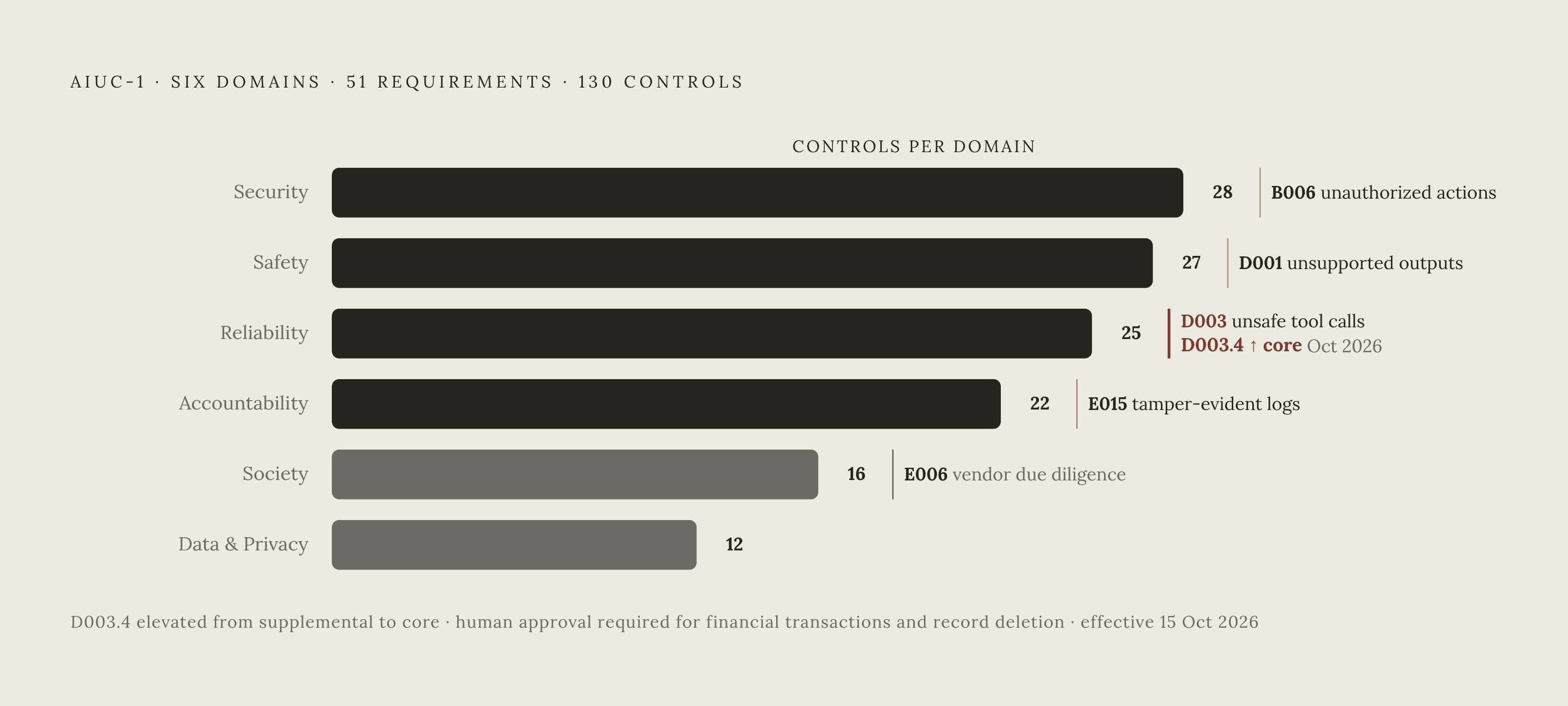
AIUC-1 is an auditable security standard built specifically for AI agents. It contains 51 requirements and 130 controls across six domains, namely Data and Privacy, Security, Safety, Reliability, Accountability, and Society. Certification attaches to a specific agent in a specific deployment context. Scope is therefore central to its usefulness. A vendor’s certificate becomes relevant to a CFO only when it covers the agent and operations used in the revenue cycle.
Data and Privacy covers limits on data access, cross-customer exposure, and PII leakage when coding tools use protected health information. Security includes adversarial testing and B006’s prevention of actions outside an agent’s authorized scope. Reliability addresses unsupported outputs through D001 and unsafe tool calls through D003. The latter requires tool allowlists, parameter validation, rate limits, and human approval for sensitive operations, including financial transactions.
Human approval deserves especially close attention here. AIUC-1’s October 15, 2026 update moved D003.4 from supplemental to core, so approval is now required for sensitive tool operations, including financial transactions and deletion of records. This provides a control mechanism relevant to WISeR’s human-accountability requirement, although approval alone does not establish that the approver is an appropriately licensed clinician. Accountability adds a different layer of evidence. E015 requires activity logging, with supplemental controls for full execution chains and tamper-evident logs, while E006 addresses vendor and model due diligence, including model provenance and source.
Testing distinguishes the standard from a policy review. AIUC conducts technical evaluations involving prompt injection, jailbreak, data leakage, and unsafe tool calls, while third-party testing across multiple domains is required at least quarterly. The October 2026 update added mandatory testing requirements A009 for data and privacy and E018 for accountability, and broadened security, safety, and reliability testing. Safety addresses harmful behavior, while Society addresses risks such as AI-enabled cyberattacks and catastrophic misuse. Those risks to the business are less immediate than a defective claim, but they still matter when vendor systems connect with CMS-related data.
The honest limits of AIUC-1 that a CFO should understand before treating it as a safe harbor
AIUC-1 is voluntary, privately governed, and has no statutory standing in healthcare law. No CMS guidance, OIG work plan, or False Claims Act enforcement action to date has named it as a safe harbor. Legal protection remains an unresolved question. AIUC accredits its own auditors, while vendors select their auditors and determine which agent and deployment context to submit. This differs from the governance arrangements behind SOC 2, ISO 42001, and NIST frameworks.
Scope discretion creates a genuine procurement risk. The standard’s definition of an agent does not eliminate vendor judgment, so certification may cover a narrow deployment while other agents operate in the same workflow. Version differences can widen that gap. Although the standard changes quarterly, an organization locks its version for one year at scoping, with annual re-certification required. A certificate against the April 2026 version therefore does not show that it covers the October 2026 additions for open-weight models, expanded testing, or mandatory human-approval controls.
A vendor that can name the certified agent, deployment, and standard version and show the audit evidence gives more assurance about that agent than a SOC 2 report or internal AI policy alone. The buyer’s discipline closes part of the gap. Contractual coverage of the actual revenue-cycle agent addresses narrow scoping, while direct verification of certification status avoids reliance on sales material. Both steps make it easier to judge the value of certification as evidence, though neither makes it a shield from liability.
Where HUD Section 232 operators face compounded audit exposure when AI touches both revenue and financial reporting
Section 232 financing adds a second audit lens. HUD requires borrowers to undergo both financial statement and compliance audits under the HUD Consolidated Audit Guide, which HUD OIG is revising chapter by chapter. Borrowers must file audited fiscal-year financials within 90 days under 24 CFR 5.801, while operators that are not also borrowers may file operator-certified statements. When AI helps with revenue projections, cost reports, or Medicare cost settlement positions, the provenance of its documentation can matter for both healthcare reimbursement and financial reporting.
HUD OIG’s April 2026 report found that HUD did not always address risks reported in Section 232 borrowers’ audited financial statements. As of June 2024, nearly 5 percent of HUD-insured Section 232 borrowers had defaulted on their mortgages, with unresolved financial statement risks identified as part of the problem. It identifies an unresolved reporting-risk environment into which AI-generated errors could enter. An operator cannot assume that the reviews already in place will fix weaknesses just because the financial statements have been audited.
The two regimes ask different questions of shared inputs. CMS seeks supportable documentation under federal healthcare program standards, while HUD seeks accurate reporting under the handbook. AI-assisted revenue recognition inputs may affect both a Medicare cost report and HUD-filed statements without satisfying both sets of requirements. E015’s activity logs and supplemental execution-chain evidence, along with E006’s due diligence, can provide an evidence trail to help trace what happened in both settings.
How should a CFO obtain AIUC-1 assurance for financial workflows through procurement and audit readiness?
What can the organization produce about its agents in a CMS audit, OIG investigation, or False Claims Act proceeding? To answer it, CFOs should first map AI tools to coding, prior authorization, clinical documentation, and utilization management workflows. Section 232 operators should extend that map to AI-supported financial reporting inputs. The map should then identify missing approval controls and the logs needed to reconstruct what each agent did and when.
Before an agent is deployed, vendors should name the certified agent, the standard version, and the deployment context the certificate covers. Contracts should require coverage of the actual revenue-cycle workflow, annual re-certification, and use of the current version at each renewal. A demo certificate is not enough here. Nor does coverage of an earlier agent or a scope excluding the workflow’s tool calls answer the CFO’s question.
Schellman is identified as fully accredited, and Coalfire as provisionally accredited, in the October 2026 certification information supplied for this article. Schellman was the first accredited AIUC-1 auditor, as recorded in February 2026. Accreditation status should be verified directly before engagement. For an AI-powered financial reporting system, the assurance scope must identify the relevant agent and deployment, then combine the controls audit with AIUC’s technical evaluations. Expertise in healthcare, HUD, and SOC examination still matters because auditors need to know the industry to judge technical test results.
The timeline sets out duties that recur but gives no estimate of how long completion will take. Technical testing occurs at least quarterly, certification renews annually, and readiness work needs comparison with the current standard. CFOs should treat those cycles as continuing governance. Contracts specifying scope, independently tested controls, and records of human approval together make system design examinable. Without a statutory safe harbor, the defensible position is evidence of how the organization governed the agent that actually influenced its financial decisions.