Cost Report Settlement Timing and Cash Flow Planning for SNFs
Medicare cost report settlements can take 18 months or longer to finalize.

A skilled nursing facility can run a full fiscal year believing its Medicare revenue is settled, only to learn 12 or 18 months later that the cash it already spent, distributed, or budgeted against was never final. That gap, between the interim payments a SNF collects all year and the number a Medicare Administrative Contractor eventually confirms, is the subject of this piece. Cost report settlement gets treated as a filing deadline to meet and a form to get right, when it is really a cash flow event with a long fuse, and the fuse just got longer.
SNF cost report settlements as a cash flow problem
Every SNF runs on interim Medicare payments all year, and because that cash arrives on a predictable schedule, finance teams can build budgets around it. That interim cash is provisional by design. The annual cost report reconciles what the facility actually earned against what it was paid, and the final settlement can move in either direction, sometimes by a wide margin. 42 CFR § 413.24(f)(4) says that, through CMS cost reporting rules, every SNF has to submit its annual cost report to its Medicare Administrative Contractor by the last day of the fifth month after the reporting period closes. Missing that date triggers immediate cash consequences.
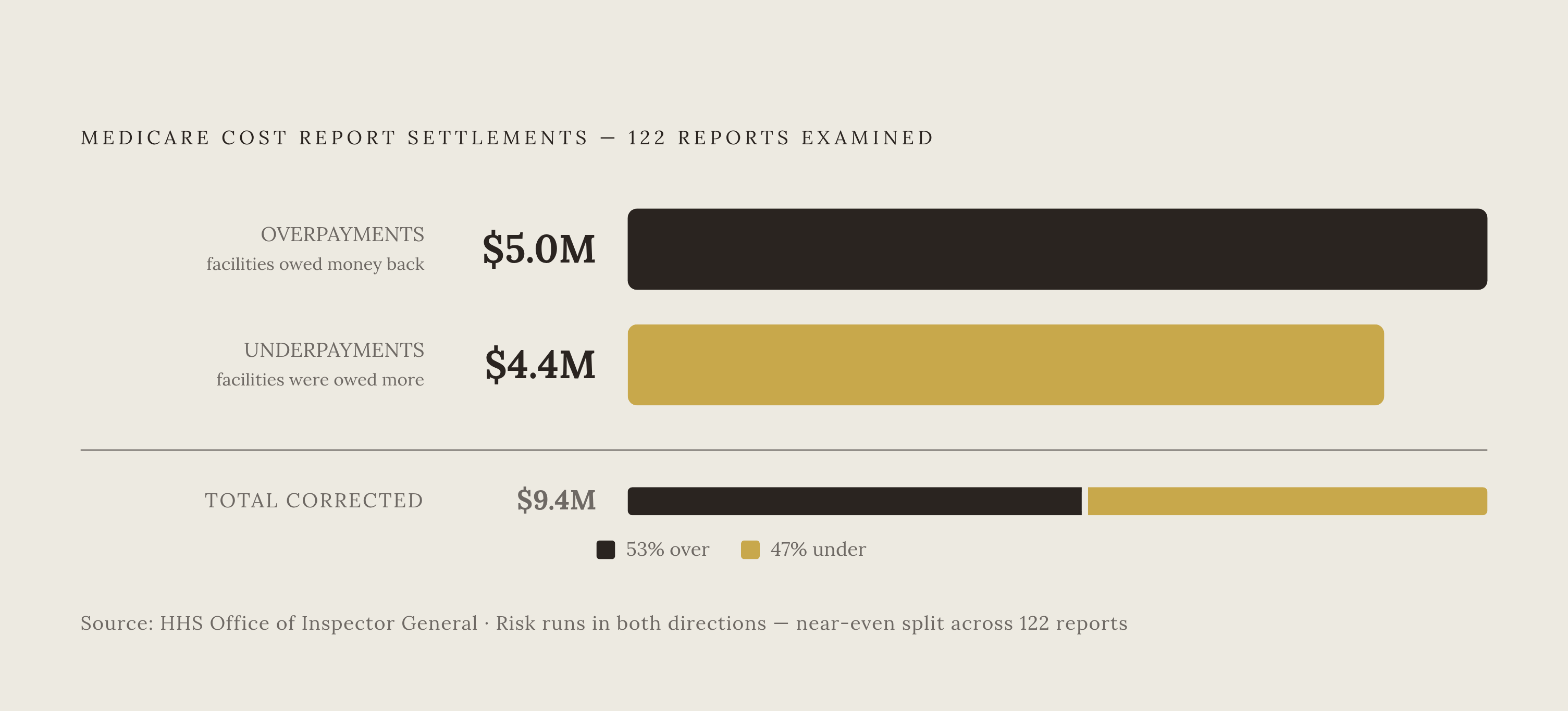
Filing on time does not end the exposure. A report that is accurate on its face can still draw an audit, and the common triggers are not exotic: misallocated expenses, inflated utilization figures, improper cost classification. Any one of them can push reimbursement back by months. The direction of the eventual correction is not predictable either. A federal inspector general looked at one Medicare contractor and found that reopenings across 122 cost reports led to corrected final settlements totaling $9.4 million, $5.0 million of it in overpayments and $4.4 million in underpayments. Some facilities in that sample owed money back. Others were owed money they hadn't collected. Few had planned for either outcome in their cash flow models, because the entire premise of planning around interim payments is that the number you're operating on is the number you'll keep. It frequently isn't.
How the settlement pipeline sequences cash exposure across time
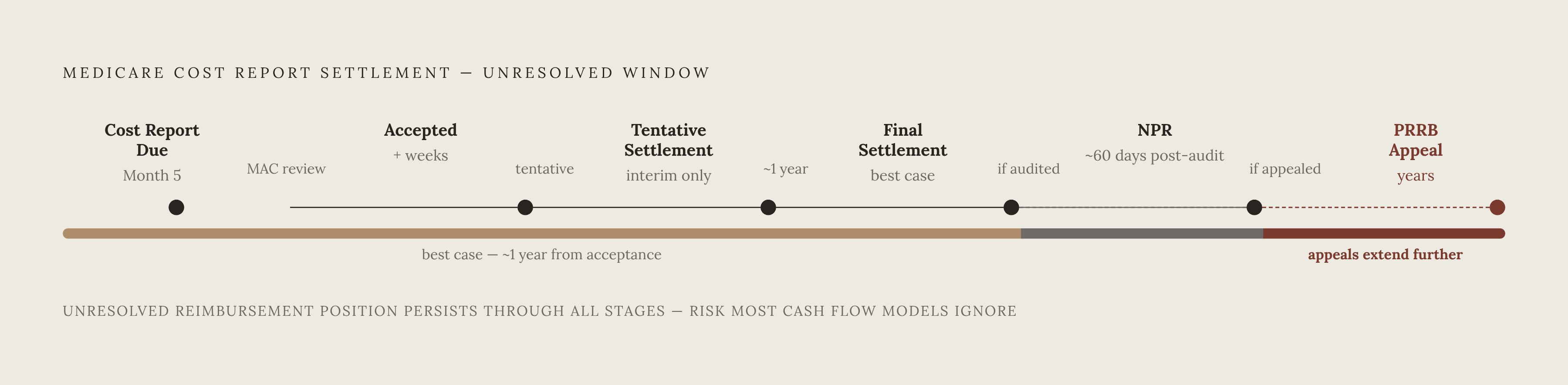
Settlement is not a single event that happens once a cost report is filed. It runs through stages, and each stage leaves the facility's actual reimbursement position unresolved for a defined stretch of time. The Medicare Administrative Contractor has a set period after receipt to review a submitted report. Tentative settlements follow within a set period after the cost report is accepted. Reports that are not selected for audit get settled within one year of acceptance. That one-year marker is a target for the simplest case, not a ceiling for every case.
For reports that are audited, the process extends further. Final settlement and the Notice of Program Reimbursement, the document that makes the number official, typically arrive about 60 days after the audit exit conference. An audited facility can sit well past the one-year mark before it has a confirmed figure to plan against. And if the facility disagrees with the Notice of Program Reimbursement on a matter of law or regulation, it can appeal to the Provider Reimbursement Review Board. That appeal has to be filed within a set number of days of the Notice of Program Reimbursement date and has to clear a minimum amount-in-controversy threshold, and once filed, it extends the unresolved period again.
A facility filing its cost report in May may not see a final settlement for a year or more. If the report draws an audit, or if the facility appeals, the wait runs longer still. So you need to plan against the interval between the interim cash a SNF collects and the final number a Medicare Administrative Contractor confirms, not the fiscal year the cost report nominally covers.
What CMS-2540-24 changes
CMS-2540-24 is the first full redesign of the SNF cost report form in 15 years, effective for cost reporting periods ending on or after September 30, 2025. A Centers for Medicare and Medicaid Services Provider Reimbursement Manual transmittal dated November 27, 2024 introduces the new form as Chapter 49 and lays out worksheet changes across the S, A, B, C, D, E, G, H, and K series. The redesign is not cosmetic. It asks for more granular data than the form it replaces, and facilities whose internal records aren't built to produce that granularity are the ones most likely to see their settlement timelines stretch.
Payor reporting is the clearest example. The old form tracked three aggregated categories: Medicare, Medicaid, and Other. A facility that has not separated its payor-specific data to that level before now has to build the capacity to do so before its next filing, not after. Worksheet S-7, the RUG days worksheet that served as a PDPM proxy, is eliminated outright, removing a data point facilities had leaned on for years. Contract labor reporting, previously limited to nursing, therapy, and other medical staff, now applies across all cost centers.
The E-series worksheets, long the most audited section of the cost report, are restructured in ways that raise the stakes further. Worksheet E is split into separate Parts A and B for Medicare Part A and Part B settlements. Worksheet E-1 now requires a Notice of Program Reimbursement date, so a facility has to track settlement timing as a mandatory data point on the form, not just monitor it informally. Related-party and home office disclosures expand in the A-series as well, and incomplete disclosure there raises both audit risk and disallowance risk, each of which pushes the settlement timeline described in the prior section further out.
The pattern across all of these changes is the same: CMS-2540-24 is a data-quality test before it is a compliance exercise. Facilities with clean, payor-specific records, full contract labor tracking across every cost center, and complete related-party disclosures will file something a Medicare Administrative Contractor can process without friction. Facilities without that infrastructure will file something more likely to draw scrutiny, and scrutiny is what lengthens the gap between interim payment and final settlement.
External financial pressures compounding the timing risk in 2025–2026
Settlement timing risk does not arrive in a vacuum. It lands at a moment when SNF revenue is falling even as costs climb, so there's less room left to absorb a lump-sum settlement adjustment when one eventually comes due. A federal commission's report to Congress recommends that Medicare cut 2025 base payment rates for skilled nursing facilities by 3 percent for fiscal year 2026. A cut of that size shrinks the revenue base against which interim payments are calculated in the first place, before any settlement adjustment enters the picture.
Cost pressure moved in an unusual way. Minimum nurse staffing requirements, originally set to take effect in May 2026, were repealed by the Centers for Medicare and Medicaid Services effective February 2, 2026, before the rule ever took hold. Facilities that had begun budgeting for the staffing mandate now face a different cost variable than planned, one that most cash flow models have not fully absorbed yet, and one that will still flow through to cost report expense reporting under the expanded contract labor and staffing sections of CMS-2540-24.
Margins give the clearest read on how much room facilities have to work with. The all-payer total margin for freestanding SNFs moved from negative in 2022 to a thin positive in 2023, an improvement, but one that varies widely facility to facility. A facility sitting at or below that thin average margin has little capacity to absorb a settlement surprise, whether that surprise is an overpayment demand it has to repay immediately or an underpayment windfall it has to wait on. Compressed margins don't just make a bad settlement outcome worse. They make an otherwise ordinary settlement adjustment, the kind the Novitas Solutions reopenings found running in both directions, into an event with real operational consequence.
HUD-insured SNFs and cash flow stress in audited statements
For SNFs carrying HUD-insured debt, the settlement gap described in the prior sections does not stop at Medicare reimbursement. It surfaces in the audited financial statements that HUD requires, and HUD is under rising pressure to act when those statements show trouble. If you leave it alone, a cash flow planning failure turns into a mortgage compliance failure for these facilities.
A review of audited financial statements found cash deficiencies disclosed for most of the properties examined. In one portfolio reviewed, the independent public accountant reported that every property in the portfolio was in a cash deficiency during each fiscal year from 2018 through 2024, seven consecutive years without resolution. For SNF operators holding HUD-insured mortgages, the lesson is direct: audited financials function as a live oversight document, not a filing formality. If a cash deficiency ties even partly to an unresolved cost report settlement, or to distributions taken before final settlement confirmed there was surplus cash to distribute, it carries real exposure under that oversight.
The calendar compounds the problem. The HUD borrower audited financial statement deadline arrives before the Medicare cost report filing deadline, so an operator with HUD-insured debt has to manage two assurance timelines at once, each with its own reporting demands and its own consequences for falling short. A facility that has not resolved its Medicare settlement position by the time its HUD financials are due has to report into that uncertainty.
Cost report settlement adjustments and timing problems for closely held SNF owners
Most SNFs are for-profit and closely held. A settlement adjustment doesn't sit quietly on the facility's books waiting to be resolved. It flows through to the owner's personal tax position, and it often does so in a tax year different from the one in which the underlying cost was actually incurred. Federal data for 2023 puts the number of freestanding SNFs at about 14,500, and those facilities furnished roughly 1.6 million Medicare-covered stays to 1.2 million fee-for-service beneficiaries, with most organized as for-profit entities. For most SNFs, settlement adjustments land on an owner's return.
The risk compounds for an owner who distributes cash based on interim payment levels before final settlement is determined. Money taken out on the assumption that the interim numbers would hold can become money the facility has to find again if a later overpayment demand arrives. The HUD OIG finding about improper fund removal from distressed properties reflects the same pattern playing out at the portfolio level: cash drawn out before the facility's actual financial position was confirmed.
The settlement timeline from the second section of this piece is what sets the length of that exposure window for the owner. If a facility's cost report clears quickly, its owner gets a shorter stretch of uncertainty to plan around. But if a facility gets audited, or its CMS-2540-24 data isn't clean enough to move through review without friction, that window extends, and the owner's tax exposure stretches with it. Coordination, not sequence, is the answer: the cost report preparer and the tax advisor need to work from the same settlement timeline, planning year-round for a range of possible outcomes, rather than treating the cost report as a once-a-year filing that belongs to someone else's desk.
AI tools entering SNF billing and cost center workflows and new assurance gaps
SNFs are adopting AI tools for billing optimization, census management, and cost center allocation, and all three of those functions feed data straight into the cost report. That dependency raises a question current audit standards were not built to answer: what assurance exists that an AI system's output is accurate enough to support a filing that a Medicare Administrative Contractor will later audit?
CMS-2540-24's data demands make the question sharper than it would have been under the old form. Settlement accuracy now depends on granular, payor-specific, cost-center-level records, and AI tools are increasingly generating or processing exactly that kind of record on a facility's behalf. A systematic error in that output doesn't stay isolated to the tool that produced it. It propagates into the filed cost report and from there into the settlement calculation itself, feeding the same E-series worksheets that already draw the most audit attention.
One framework built specifically for this gap is AIUC-1, launched in 2025 by the Artificial Intelligence Underwriting Company. It targets risks specific to AI agents, including prompt injection and unauthorized agent actions, risks that fall outside what existing certifications like SOC 2 were designed to cover. Its controls span six domains: Safety, Security, Reliability, Accountability, Data & Privacy, and Society. For service organizations handling SNF billing, claims administration, or financial data processing, SOC 1 examinations under SSAE 18's AT-C 320 evaluate controls relevant to a user entity's financial reporting, and a SNF relying on a billing vendor should know whether that vendor's SOC 1 report actually covers the controls feeding its cost report data. AIUC-1 is new enough that its adoption across SNF vendors remains limited, but it marks the direction assurance standards for AI in financial workflows are heading, worth watching as it develops.
Building a cash flow plan that accounts for settlement timing gaps, lump sums, and new reporting demands
A cash flow plan built only around interim payment levels can't hold up on its own. It's a bet that settlement will go smoothly, arrive on schedule, and produce no surprises, and the Novitas Solutions reopening data alone, running in both directions across 122 reports, shows that bet does not reliably pay off.
You start the fix by mapping the settlement timeline directly onto the fiscal calendar. You get the five-month filing deadline, the roughly 90-day tentative settlement window, the one-year target for reports that aren't audited, and the audit-exit-plus-60-day sequence for Notice of Program Reimbursement, all foreseeable markers. None of them require knowing the final settlement amount in advance, and all of them can be built into a cash flow model well before that amount is known.
A reserve for lump-sum outcomes in both directions belongs in that model as well. An overpayment demand needs cash on hand immediately, with no grace period built into the structure. You need to treat an underpayment windfall as delayed revenue rather than money available for distribution, and hold it until final settlement actually confirms the facility has surplus cash to work with. That distinction matters most for the closely held owners described earlier in this piece, where a distribution taken too early against an unconfirmed number can become a repayment obligation later.
None of this removes the uncertainty settlement timing creates. It builds a structure sturdy enough to hold that uncertainty without the facility, the owner, or the HUD-insured mortgage behind it absorbing the full shock when the final number finally arrives.