Minimum Data Set Coding Accuracy and PDPM Audit Risk
Coding errors in SNF assessments now trigger a sequence of escalating CMS audits and OIG referrals.

The Minimum Data Set determines what Medicare pays a skilled nursing facility for every day of a covered stay, and under the Patient Driven Payment Model, that makes each coding choice a billing decision. This piece traces how that shift turns routine assessment errors into audit exposure, what CMS's enforcement pipeline actually looks like in sequence, and what a November 2025 OIG audit of one facility suggests about what comes next for the rest of the industry.
Why the MDS Became a Financial Instrument Under PDPM
Before PDPM, Medicare reimbursement for skilled nursing care followed therapy minutes. PDPM inverted that relationship. A single assessment, completed within days of admission, determines what the facility is paid for weeks for care that has not yet been delivered.
That structure means a coding error made at admission does not get corrected by better documentation later in the stay. It compounds, because every day billed against that HIPPS code carries the error forward until an Interim Payment Assessment resets it, and many stays never trigger one. The same logic now extends into Medicaid. Many states required nursing homes to adopt a new Medicaid PDPM reimbursement model by or around October 1, 2025, the CMS-mandated deadline, but the exact transition date varied by state. MDS accuracy sits underneath both payer streams at once: a facility is not managing one reimbursement risk but two, from the same assessment.
When a clinical assessment generates a payment amount, every field on that assessment carries financial weight, not just clinical meaning. An inaccurate code is a payment integrity failure the moment it is submitted, whether or not anyone intended it that way.
Recurring Patterns in Coding Errors
MDS coding errors are not evenly distributed across the assessment.
Primary diagnosis selection causes more downstream damage than any other single field. The correct primary code at that point is aftercare following surgery for fracture, not the acute fracture itself. If the primary diagnosis does not match what the medical record supports, the resident falls into the wrong PDPM clinical category and the HIPPS code is wrong before any other field on the assessment is even reviewed.
Diagnosis validation failures compound the problem. A diagnosis should never be coded simply because it appears somewhere in the chart. Dysphagia is a specific, recurring version of this problem: speech-language pathology evaluations often identify it clinically before physician documentation catches up, leaving a real clinical finding with a documentation gap behind it.
Specificity failures are a separate, more mechanical category. Selecting an unspecified code when a more specific one is available and supported by the record is a codeable error on its own, one that draws audit attention and can generate Return to Provider notices before the claim even reaches adjudication.
Section GG functional scoring is its own risk area. Chart notes, therapy documentation, and the care plan all need to align with what Section GG reports, not approximately but completely.
ICD-10 mapping currency adds a structural layer on top of all of this. Effective October 1, 2025, CMS finalized 34 changes to the PDPM ICD-10 code mappings as part of the FY 2026 SNF PPS Final Rule, CMS-1827-F. A facility that built reliable PDPM coding practices in prior years is not automatically compliant today if its annual ICD-10 maintenance has lapsed. That is a structural risk sitting quietly in a facility's coding reference materials, not a one-time clerical slip.
The pattern that ties all of these together, and the one most likely to escape internal review, is the gap between coding and documentation. Under PDPM, the primary diagnosis has to connect to the daily skilled care needs documented in the clinical record. A diagnosis can be coded correctly, pass internal coding review cleanly, and still fail an external audit if the daily skilled care notes do not explain why that diagnosis requires skilled intervention. Missing physician orders occur constantly in this category, particularly on readmissions, where the new admit-to-skilled-care order for the readmission date is simply absent from the chart.
The Audit Pipeline: From Data Validation to OIG Referral
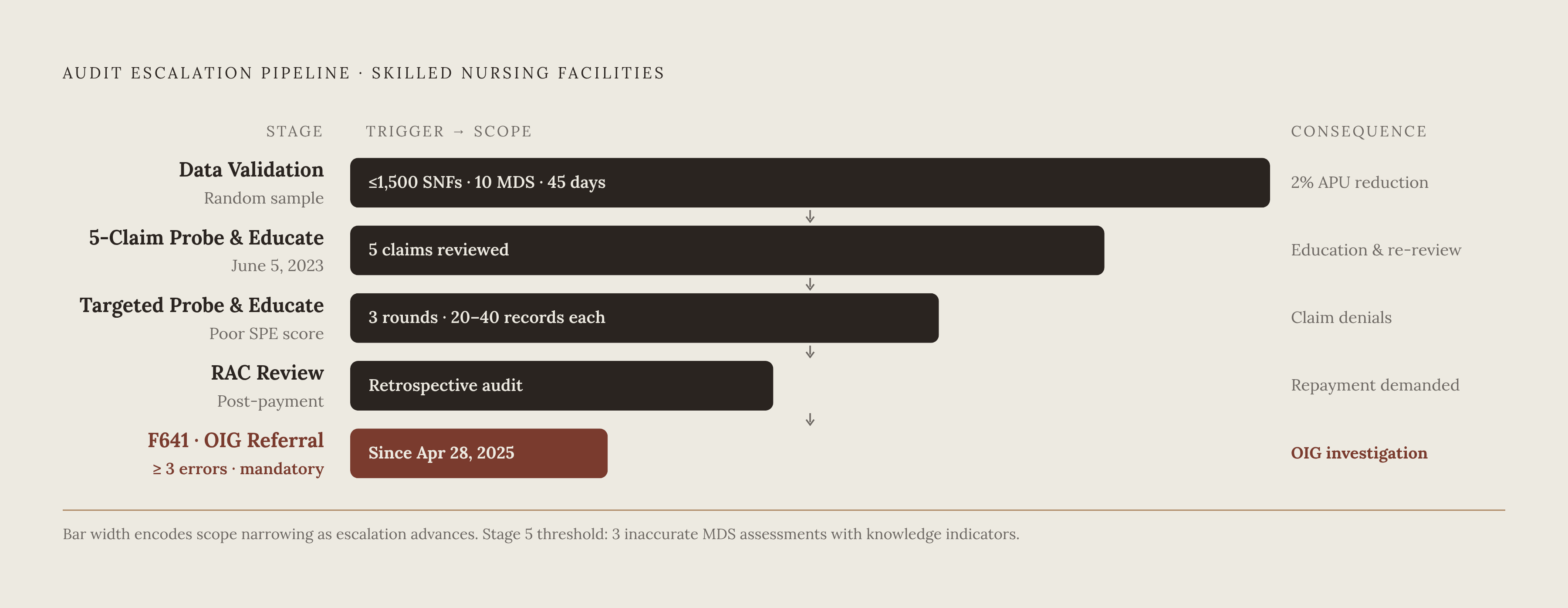
CMS has not built a single audit mechanism for PDPM compliance. It has built an overlapping set of them, and a facility with systemic coding errors faces not one review but a sequence of escalating ones, each feeding the next.
The SNF Data Validation Program begins the funnel. Starting in FY 2026, CMS selects a random sample of up to 1,500 SNFs each fiscal year, administered by contractor Healthcare Management Solutions, LLC, with selections beginning mid-January 2026. Selected facilities have to provide documentation supporting up to 10 MDS assessments within 45 days of notice. Missing that deadline results in a finding of non-compliance and a 2% reduction in the Medicare Annual Payment Update, a penalty triggered by the failure to respond, independent of whatever the underlying documentation would have shown.
Running alongside data validation is the SNF 5-Claim Probe and Educate program, SPE, launched June 5, 2023. If a facility scores poorly on those five records, it moves into Targeted Probe and Educate, TPE, which involves up to three rounds of review, each covering 20 to 40 records. CMS has layered Recovery Audit Contractor reviews on top of this pre-pay pathway, adding a retrospective, post-payment audit on claims a facility may have assumed were settled.
The sharpest edge of the pipeline is the surveyor referral pathway under F641, Accuracy of Assessments. On April 28, 2025, CMS changed the policy governing this tag: surveyors are now required to refer patterns of inaccurate MDS assessments directly to the OIG, where a pattern is defined as three or more instances, when there are indications the staff member knew the coding was inaccurate. CMS's guidance language is specific about what counts: a pattern within a nursing home of clinical documentation or MDS assessment practices that result in higher PDPM scores, untriggered Care Area Assessments, or unflagged Quality Measures, where the information does not accurately reflect the resident's status, may be indicative of payment fraud or an attempt to avoid reporting negative quality measures. Schizophrenia diagnoses remain under particular scrutiny within this enforcement environment: CMS launched audits of schizophrenia diagnosis use in early 2023 over concern that the diagnosis excludes residents from a quality measure tracking antipsychotic drug use, and facilities are still facing penalties from those reviews.
A steady operational cost runs underneath all of these formal programs: the Additional Documentation Request. Insufficient medical record documentation can produce inaccurate MDS coding, which in turn prompts ADRs. Leadership should be tracking ADR volume, reason codes, request types, and the financial amount at risk, including post-payment claims that can be clawed back in full or in part well after the money has already been reimbursed and booked.
The Pinnacle Multicare OIG Audit
The HHS Office of Inspector General's audit of Pinnacle Multicare Nursing and Rehabilitation Center, a 480-bed facility in the Bronx, found that 99 of 100 sampled PDPM claims did not comply with Medicare requirements. On top of that, Pinnacle billed Medicare for services provided to enrollees who did not require skilled nursing services at all, in 54 claims, and billed for services that failed to meet Medicare documentation requirements in 2 more.
OIG's recommendations were correspondingly direct: refund $31.2 million to the Medicare program, conduct internal audits of claims both before and after the audit period, and provide additional training to clinical and billing personnel. Pinnacle did not concur with any of it. If auditors treat a minor documentation gap identically to substantive billing fraud, facilities absorb financial exposure for errors that never produced an actual overpayment.
The audit's significance is not contained to Pinnacle. OIG stated explicitly that this audit is "the first in a series of audits of SNFs that billed for skilled nursing services under the PDPM." The evidentiary method used at Pinnacle, HIPPS code against medical record, sampled and extrapolated, is the likely template for audits reaching other facilities. What a facility should take from this case is not the dollar figure but the test itself: does the medical record support the HIPPS code that was submitted? That question, asked claim by claim, is the standard every SNF billing under PDPM is actually being measured against.
The "Immaterial Error" Defense
Pinnacle's materiality argument deserves a fair hearing before it gets answered. Facility leadership reasonably wants a system that distinguishes a genuine documentation shortfall, caught in the middle of a pandemic, from deliberate upcoding designed to inflate reimbursement. That distinction matters to anyone trying to run a facility in good faith.
But the audit standard CMS applies has no severity dial. The test is whether the medical record supports the HIPPS code as submitted, and that test returns a yes or a no. The RAI Manual sets the coding expectations auditors use as their baseline, and a facility that has departed from those expectations carries the burden of explaining the departure, not the auditor the burden of proving it was significant.
The F641 policy change tightens this further. A pattern, for referral purposes, is three or more instances. That threshold is low enough that a handful of errors a facility genuinely considers isolated and immaterial can, in aggregate, constitute a reportable pattern that triggers an OIG referral regardless of intent to defraud.
The practical consequence follows directly: a facility cannot manage audit risk by arguing about materiality after the fact. The documentation gap has to be prevented before the review happens, because once a pattern is identified, the referral pathway activates based on the pattern itself, not on the dollar amount of any resulting overpayment. This also corrects a misunderstanding that persists in a lot of SNF leadership: that because a claim was paid, the coding behind it must have been acceptable. Post-payment RAC audits exist precisely because reimbursement is not a clean bill of health. Money already received can still be demanded back.
What systematic prevention requires across the assessment lifecycle
MDS errors do not originate at the moment the assessment is completed. They originate throughout the resident's stay, which makes continuous, interdisciplinary prevention necessary.
Diagnosis work should begin at admission, not at the assessment reference date. Facilities that consistently achieve accurate reimbursement validate diagnoses throughout the stay rather than waiting until MDS completion to review them, because waiting until the ARD leads to missed opportunities and coding inaccuracies that are harder to catch after the fact. Every discipline has a role here: nursing assessments, therapy evaluations, physician documentation, medication reviews, lab findings, diagnostic imaging, dietary assessments, and consultant reports all contribute to establishing which diagnoses are genuinely active and require coding.
Primary diagnosis selection specifically benefits from interdisciplinary coordination. A diagnosis that shows up on the MDS but not in the care plan is a documentation inconsistency surveyors will flag.
Annual ICD-10 mapping maintenance is not optional upkeep, it is a condition of continued PDPM readiness. The October 1, 2025 mapping changes under CMS-1827-F needed to be reflected in a facility's coding reference materials before claims were submitted.
Internal audit cadence should focus specifically on high-risk areas identified through the error taxonomy above, using reporting to catch patterns of upcoding or downcoding before they escalate into external findings. Auto-generated data still has to be reviewed and confirmed accurate by a human before it is submitted.
Staff support underpins all of it. Staff should understand the penalties associated with falsification because the F641 referral pathway can implicate individual clinicians directly, separate from whatever happens to the facility as a whole.
AI-assisted coding tools add a newer variable to this picture. As SNFs adopt AI for coding review and clinical documentation auto-population, the accuracy of those tools becomes part of the compliance equation: an MDS error traced to a system output rather than a human judgment call still produces the same audit exposure. Schellman became the first accredited AIUC-1 auditor in February 2026. For a billing vendor or EHR platform using AI to auto-populate MDS fields, AIUC-1 certification offers a facility a basis for arguing that the tool itself has been independently audited, which matters when a facility's defense depends on showing its processes, automated ones included, are actually controlled. It is a due-diligence question to raise with vendors, not a substitute for the human review that still has to happen before submission.
Executive and Board-Level Oversight of MDS Accuracy as a Compliance Obligation
MDS assessments get completed at the facility level, by individual MDS coordinators working against individual residents' charts. Between the F641 escalation pathway and CMS's aggressive, multi-layered audit strategy, this is a matter demanding vigilance from corporate clinical leadership, the people responsible for cost containment and quality measures across an entire organization, not only from the coordinator completing the assessment.
Leadership that treats inaccurate MDS assessments as a back-office clinical detail is missing where the financial exposure actually lands. A facility whose financial statements are distorted by an unresolved overpayment demand or an open audit finding is carrying a compliance problem that reaches all the way to HUD.
An external, independent audit of MDS coding and clinical documentation, conducted by an advisory firm with specific skilled nursing compliance expertise, serves the same function here that a financial statement audit serves for any organization. It produces an independent answer to whether what the facility is reporting reflects what actually happened, answered before a government auditor reaches the same question with enforcement authority already behind it. Commissioning that review voluntarily is a fundamentally different posture for leadership to occupy than discovering the same gap through an ADR, or worse, through an OIG referral triggered by a pattern nobody caught in time.