CMS Annual SNF Prospective Payment System Rate Update Impact
The 3.2% payment bump masks facility-specific variation in wages, case-mix, and compliance.

The FY 2026 SNF PPS final rule sets a 3.2% payment update, but that number is a composite of three separate inputs that move independently of each other, not a single stable figure an operator can simply plug into next year's budget. This piece works through each layer standing between that headline percentage and what an individual facility actually collects: PDPM case-mix, the wage index, the VBP withhold, ICD-10 mapping changes, and QRP compliance. Taken together, they show why the 3.2% figure is a starting point for a facility-specific model, not an answer in itself.
The FY 2026 SNF PPS Final Rule and the 3.2% Update
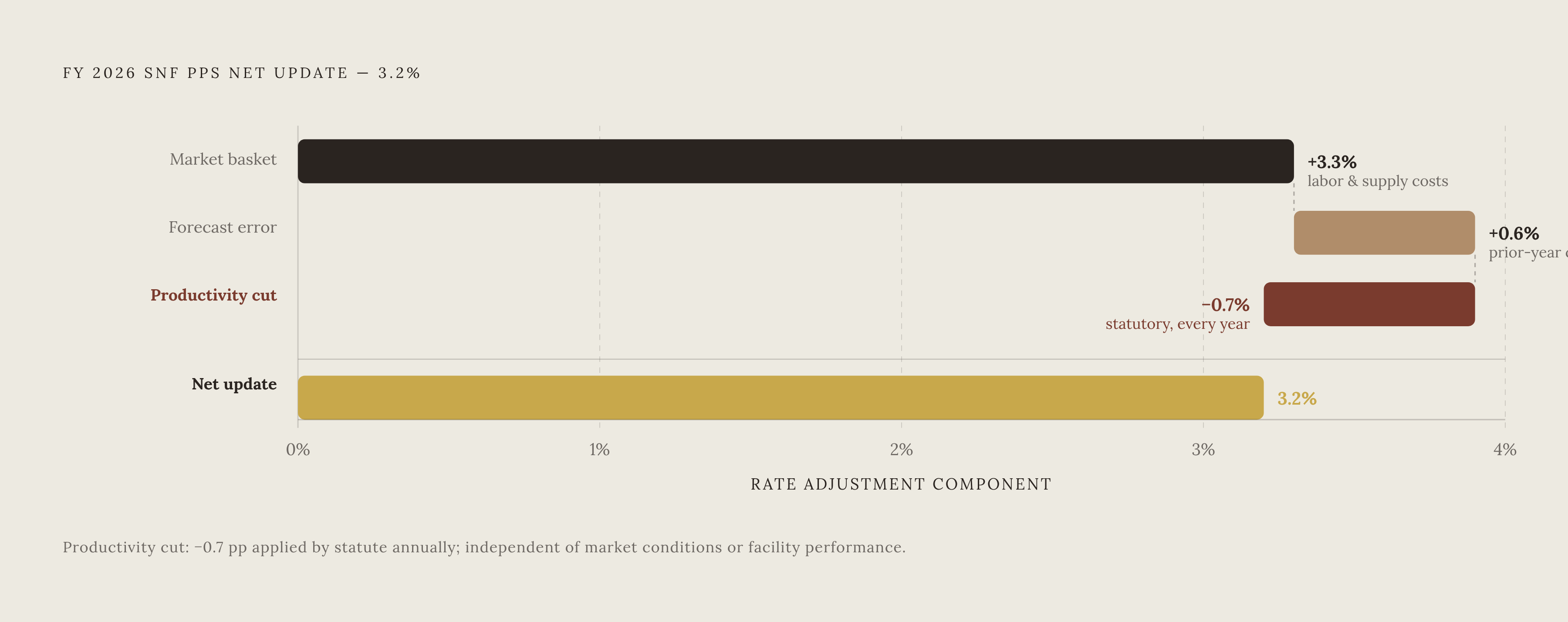
CMS finalized the FY 2026 SNF PPS rule on July 31, 2025. It takes effect October 1, 2025, and was published in the Federal Register on August 4, 2025. The 3.2% net update is built from three pieces that each behave differently: a market basket increase of 3.3%, which reflects CMS's forward-looking projection of the prices SNFs will pay for labor, supplies, and other inputs; a positive 0.6% market basket forecast error adjustment, a backward-looking correction that only shows up when a prior year's price forecast missed actual inflation by a wide enough margin; and a negative 0.7% productivity adjustment, a statutory cut applied every year regardless of what the other two components do. Combined, these three produce the 3.2% figure CMS has attached to an estimated $1.16 billion increase in SNF PPS payments nationwide compared to FY 2025.
The proposed rule, issued April 11, 2025, carried a lower number built from a lower market basket estimate, the same forecast error adjustment, and a slightly larger productivity cut. All three components moved between April and July, and the final figure came in higher than the proposed one. That gap matters for anyone who builds a budget off a proposed rule rather than waiting for the final text: between April and July, CMS's own estimates of labor and supply cost trends shifted enough to change the bottom line.
It is worth asking what happens to this figure next year, since none of its three components are fixed by nature. The market basket will respond to whatever labor and supply cost trends come up over the coming year. If CMS's FY 2026 price projections overstate actual inflation, the forecast error adjustment can turn negative, so next year's true-up works against operators. The productivity cut, by contrast, is a structural feature of the statute and will recur regardless of economic conditions. Treating 3.2% as a single, stable number conceals the fact that it is really three separate bets, each capable of moving in a different direction the next time CMS revisits the rate.
PDPM Case-Mix Components and Facility-Specific Dollars
The 3.2% figure applies to the SNF PPS per diem structure, but that per diem is not a flat number. Under the Patient-Driven Payment Model, each Medicare Part A day is reimbursed through five case-mix components, physical therapy, occupational therapy, speech-language pathology, nursing, and non-therapy ancillary services, plus a non-case-mix component that covers room and board. Each resident is classified into a case-mix group within each of those five components based on clinical characteristics, and each group carries its own payment weight, so the rate update applied across this entire structure has a dollar effect that depends heavily on where a facility's residents actually land within it.
A facility with a population weighted toward higher nursing and NTA case-mix groups starts from a richer base per diem than one serving a lower-acuity census. Apply the same 3.2% update to both, and the higher-acuity facility gets a larger dollar increase per patient day, because the payment model tracks clinical need in setting its dollar amounts.
Length of stay complicates the picture further. PDPM uses a variable per diem schedule that steps down NTA and PT/OT payments as a stay continues, on the theory that resource use, particularly for non-therapy ancillary services and therapy itself, tends to be front-loaded in a stay. If a facility's average length of stay is shorter, it keeps more of its billed days inside that higher early-stay payment window. A facility with longer average stays sees more of its days fall into the stepped-down portion of the schedule, which pulls its blended per diem down independent of anything CMS did with the FY 2026 rate update.
Put those two mechanics together: two facilities with the same census size can see materially different revenue lifts from the same 3.2% update, driven by differences in case-mix group distribution and average length of stay. A facility that built its revenue model on last year's case-mix assumptions and simply updated the percentage is working from a stale baseline if its admission pattern has shifted toward higher acuity, or if its length-of-stay profile has changed, since the rate update was last modeled.
Wage Index and the Per Diem Before Case-Mix
Before PDPM case-mix enters the calculation at all, CMS adjusts the labor-related share of the SNF per diem using an area wage index tied to the facility's geographic location. This adjustment exists to account for the fact that labor costs, which make up the majority of a SNF's operating expense, vary substantially by region. The practical effect is that a facility's effective rate update can land well above or well below the 3.2% national aggregate depending purely on where it sits on the map.
If a facility is in a market with a falling wage index, its net update can run well below 3.2%, driven purely by that geographic shift rather than by any change in its clinical operations or case-mix profile. A facility in a market with a rising wage index may see the opposite: an effective update that exceeds the national figure. The correct order of operations for building a revenue model starts with the facility's published FY 2026 wage index value and layers case-mix assumptions on top of that, not the reverse.
Wage index differs from every other variable in this piece in one important respect: it cannot be improved through better documentation, better coding, or better clinical practice. It is a function of geography, full stop on the mechanism, and the only thing an operator can do with it is know the correct figure and apply it correctly. A facility that models its FY 2026 revenue off the national 3.2% aggregate without substituting its own wage index value is starting from the wrong number before PDPM case-mix, VBP, or QRP ever enter the picture.
The VBP Withhold: 3.2% as a Gross Figure
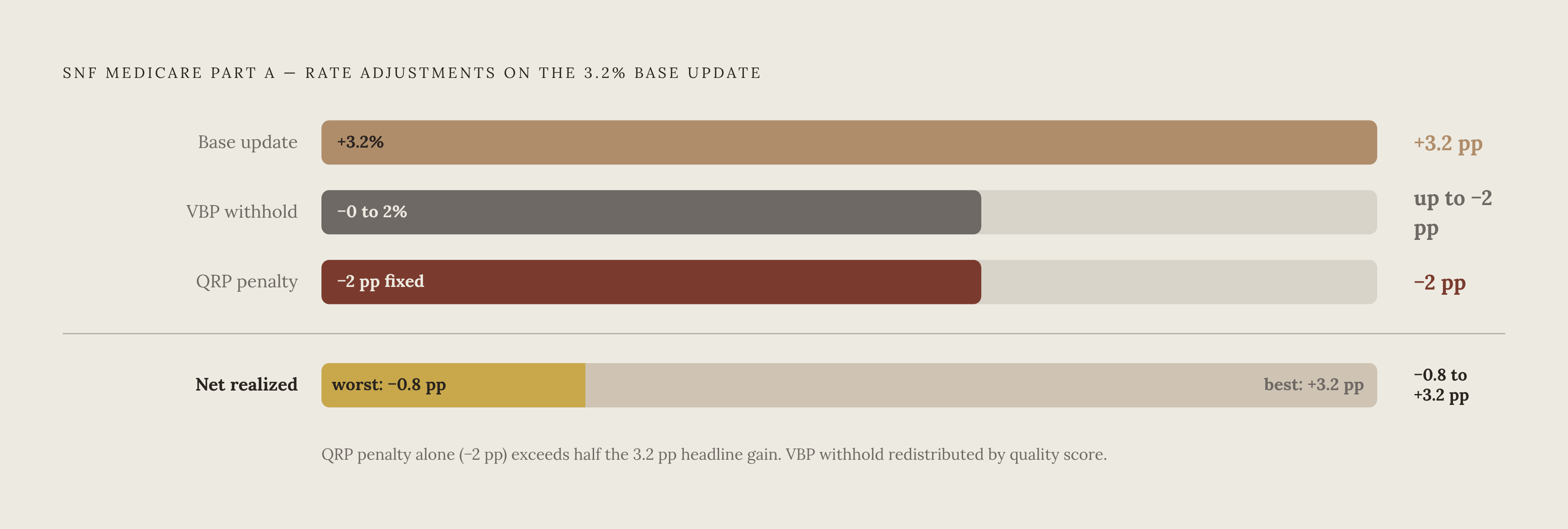
Even a revenue model that correctly applies wage index and case-mix assumptions is still describing gross revenue, not what a facility will actually collect. CMS withholds 2% of every SNF's Medicare fee-for-service Part A payments to fund the SNF Value-Based Purchasing Program, and is required to redistribute a portion of that withhold back to SNFs as incentive payments based on quality performance. For FY 2026, VBP adjustments total hundreds of millions of dollars program-wide, an offset that does not appear anywhere in the headline 3.2% figure and is distributed unevenly based on how each facility scores.
A facility that performs well on VBP's quality measures may recover most or all of its 2% withhold, which partially offsets the mechanism's bite against the rate update. A facility that underperforms may see little or none of it returned, and in the worst case, the withhold eats into the rate increase enough to offset it substantially or wipe it out. Because VBP incentive payments are applied prospectively to all Medicare FFS Part A claims beginning October 1 of the program year, they flow through the exact same claims stream as the base rate update. That makes the two inseparable for cash-flow modeling purposes, even though they are governed by entirely separate rules and timelines.
VBP is also not a static program. CMS finalized the removal of the Health Equity Adjustment from the VBP scoring methodology beginning with the FY 2027 program year, and finalized a new reconsideration process that lets SNFs appeal initial Review and Correction decisions before the affected data becomes public. Looking further out, CMS will replace the SNF All-Cause Readmission measure with the Within-Stay Potentially Preventable Readmission measure starting in FY 2028, and performance standards for both FY 2028 and FY 2029 have already been finalized. A facility building a VBP assumption into its FY 2026 revenue model is really building the first year of a multi-year model, since the measures and scoring methodology it will be judged against are already scheduled to change.
ICD-10 Mapping Changes and PDPM Clinical Category Assignments
CMS finalized 34 changes to the PDPM ICD-10-CM code mappings, effective October 1, 2025, intended to keep PDPM aligned with current ICD-10-CM coding guidance. These changes carry substantive weight for billing, not just administrative housekeeping. PDPM uses a resident's primary diagnosis to assign that resident into a clinical category, and that clinical category then determines which PT, OT, and SLP case-mix groups the facility can bill against. Changing the mapping means a diagnosis that once triggered one clinical category may trigger a different one, or none that qualifies for a skilled stay.
Among the removed codes are diagnoses CMS considers too vague, or too unlikely on their own, to justify a skilled inpatient stay: Type 1 diabetes without complications, obesity, anorexia, bulimia, and hypoglycemia. Their removal reflects CMS's stated goal of pushing toward more accurate, clinically specific coding. The MDS assessment requires that the primary diagnosis actually be the reason skilled services are being furnished, and the mapping changes tighten what qualifies as a legitimate basis for that determination. Improper coding under the new mappings can lead either to missed reimbursement or to audit exposure, depending on which direction the error runs.
What happens if a facility's MDS assessment software or billing system isn't updated to reflect the new mappings by October 1? Claims that use the affected codes get categorized incorrectly, which produces either underpayment or an improper payment flag that draws audit scrutiny, neither of which is a good outcome. From an audit standpoint, recorded revenue tied to a clinical category assignment driven by a now-removed code is revenue that will not hold up under review. Auditors examining claims submitted after October 1, 2025 need to confirm that those claims rely only on valid FY 2026 mappings, which makes this a claims-level verification question, not something that can be waved through at the rate level.
The QRP 2-Percentage-Point Penalty as a Third Revenue Variable
Layered on top of the rate update and the VBP withhold is a third, entirely separate financial mechanism: the SNF Quality Reporting Program's Annual Payment Update penalty. SNFs that fail to meet QRP reporting requirements face a 2-percentage-point reduction to their Annual Payment Update. Measured against a 3.2% rate increase, a 2-point penalty eliminates more than half the gain. This is large enough that it belongs in a revenue model as a contingent liability, not filed away as a background compliance checkbox.
CMS finalized the removal of four social determinants of health data elements from the MDS for residents admitted on or after October 1, 2025: one item on living situation, two on food, and one on utilities. That reduces the overall reporting burden, but it also narrows the margin for error on whatever elements remain, since there are fewer data points to average across if something goes wrong on one of them. CMS also finalized an amended reconsideration policy that lets SNFs request an extension to file a reconsideration request and expanded the grounds on which CMS can grant one, a real procedural protection for facilities that catch a reporting discrepancy after the fact.
What this produces is three distinct financial levers, the base rate update, the VBP withhold outcome, and the QRP compliance penalty, that all act on the same underlying revenue stream at the same time. A facility that estimates each one in isolation, assuming the full 3.2% update, a neutral VBP outcome, and full QRP compliance, will arrive at a different number than a facility that models all three as interacting variables that can move independently and simultaneously. That difference is exactly the gap between a revenue projection and an auditable one, which is the subject the next section turns to.
Layered Complexity in the Medicare Cost Report and Financial Statement Audit
Pulling the preceding sections together, the real revenue impact of the FY 2026 update depends on at least five interacting variables: the market basket and productivity components behind the 3.2% figure, the facility's specific wage index, its PDPM case-mix distribution, its VBP outcome, and its QRP compliance status. A cost report or financial statement that reflects only the headline 3.2% applied uniformly across patient days is not describing what actually happened in the facility. It needs documented assumptions for each of the five variables, built and preserved in a form an auditor can trace back to its source.
A sound approach pairs the FY 2026 revenue forecast with a documented, auditable set of inputs: case-mix drawn from trailing claims data, the facility's actual FY 2026 wage index value, a VBP withhold figure paired with an explicit estimate of expected payback, and a clear split between pre- and post-October 1 rates. If the forecast and the eventual cost report are built from the same documented assumptions, both tell a consistent story to lenders, owners, and CMS, rather than diverging in ways that raise questions during review.
Facilities operating on a non-federal fiscal year face a specific wrinkle here: within a single cost-reporting period, they will have both pre-October 1, 2025 rates and post-October 1, 2025 FY 2026 rates in effect, and those two rate regimes need to be stratified correctly within the cost report. Getting that stratification wrong is a direct audit finding waiting to happen. VBP adds its own timing complication: the incentive payment depends on quality scores that may not be fully determinable until after the cost-reporting period has already closed, and that creates an accrual timing question that needs to be addressed explicitly.
The ICD-10 mapping changes add a claims-level dimension to all of this. Auditors reviewing claims submitted after October 1, 2025 need to confirm that recorded revenue reflects only valid FY 2026 code mappings, a review that has to happen at the level of individual claims, not just at the level of the rate applied. More broadly, auditors evaluating a SNF's financial statements need to look at whether recorded revenue appropriately reflects actual PDPM case-mix, the correct wage-index adjustment, and the net VBP outcome, together, rather than accepting the headline rate applied uniformly to total patient days.
For facilities operating under HUD-insured mortgages governed by Section 232, the stakes go beyond the Medicare cost report. The same revenue figures that feed that cost report also underpin loan compliance and post-closing reporting under HUD's Consolidated Audit Guide, so an undocumented assumption in the Medicare-facing numbers can reappear as a problem in a lender-facing review. Facilities that build their FY 2026 revenue model around documented, auditable assumptions for each of the five variables, and keep those assumptions consistent across the forecast, the cost report, and the financial statements, are in a materially stronger position when audit season and lender review both arrive than facilities that wait and adjust a single line item after the fact.
Sources
- FY 2026 Skilled Nursing Facility (SNF) Prospective Payment System Final Rule (CMS-1827-F)
- Fiscal Year 2026 Skilled Nursing Facility Prospective Payment System Proposed Rule CMS 1827-P Fact Sheet
- FY2026 SNF Final Rule: Modeling the Rate Increase
- CMS Releases Final Rule for FY 2026 Skilled Nursing Facility Payment Updates