State Medicaid Rate Methodology Differences for SNFs
Five states chose different Medicaid rate methods after RUG-IV's sunset.
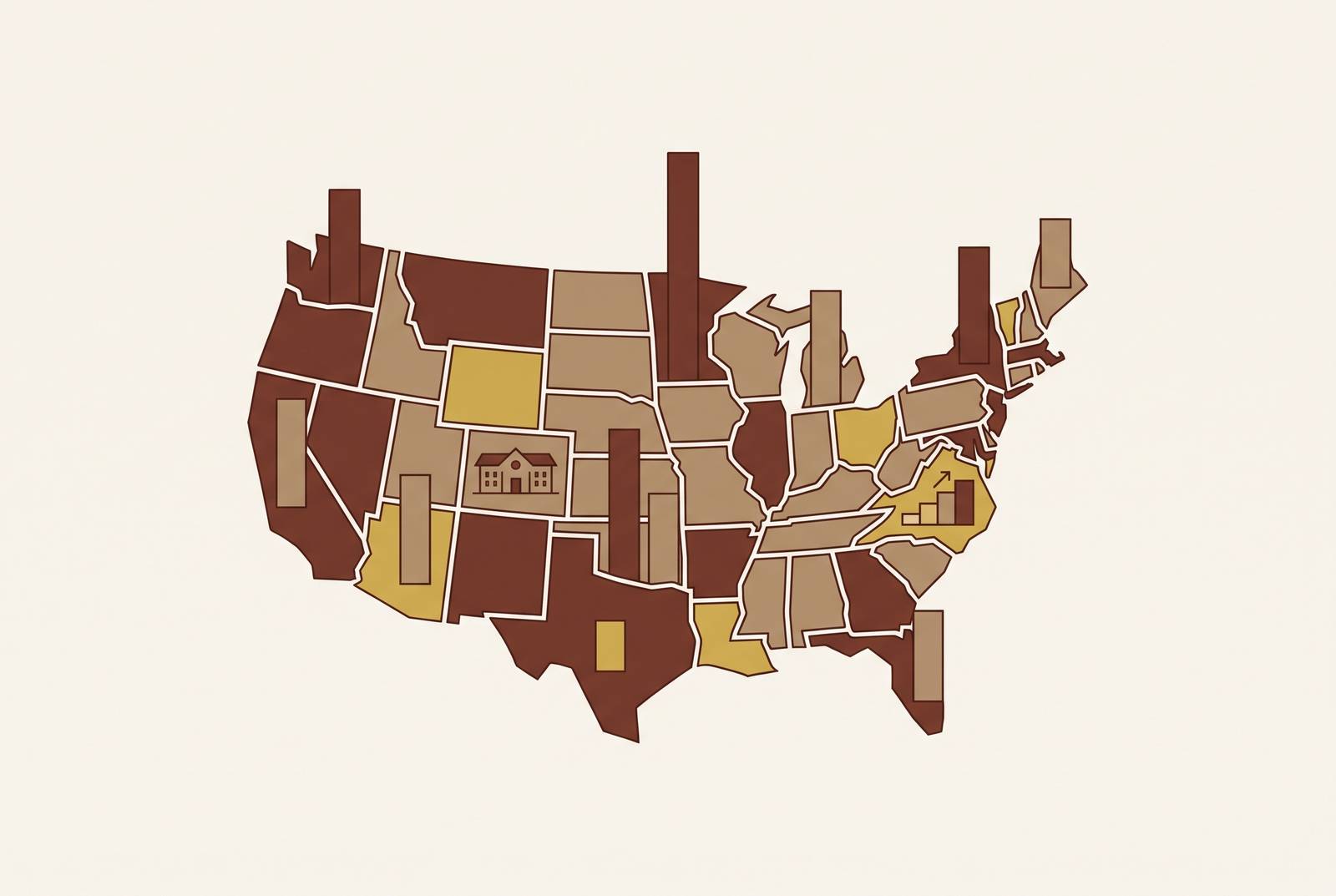
Medicaid reimbursement for skilled nursing facilities is a patchwork of fifty payment methods, and each one reflects state policy choices made within broad federal boundaries. The consequences of that fragmentation reach directly into how a facility documents costs, schedules assessments, and manages audit risk. Understanding which methodology a state uses, and how that methodology has shifted since the RUG-IV sunset, is a revenue and compliance matter, not an academic exercise.
Federal law establishes the outer boundary through 42 CFR 447 Subpart C, but it deliberately leaves method, component design, and update cycles to the states. The statute sets a floor of reasonableness rather than a uniform formula. No two states are required to use the same rate-setting logic, and most do not.
The practical consequence deserves emphasis. The inputs, assessment schedules, and case-mix components may be entirely different from what the Medicare program uses. An operator who assumes the two systems align is the most exposed operator in this landscape, because the error compounds silently until it reaches the revenue line or the audit file.
The four broad methodology families and what distinguishes them
State Medicaid rate methodologies cluster into four recognizable families: cost-based, price-based, case-mix-adjusted, and blended. Each family carries distinct implications for what a facility must document and optimize, which means the taxonomy is not descriptive trivia but a working map. Cost-based systems derive rates from audited cost reports for a defined base year. The state audits those reports, conducting desk audits on all filings plus a minimum number of field audits selected on a risk basis, and trends costs forward to the payment period. North Carolina's prospective system is built this way. What a facility controls in a cost-based state is the accuracy and completeness of its cost-report filings, the classification of allowable costs, and the treatment of related-party disclosures. The risk is simple: if the base year is stale, rates lag actual cost inflation until the state rebases.
Price-based, prospective systems operate differently. The state sets a rate by cost center rather than deriving it from each facility's individual reported costs. Rate adequacy in a price-based state depends entirely on how frequently the state updates its price benchmarks. Controlling costs more tightly does not improve the base rate.
Case-mix-adjusted systems include a component that varies by resident acuity, typically calculated from MDS assessment data and applied to the direct-care portion of the rate. States differ sharply on which case-mix tool they use: full PDPM, the PDPM nursing component only, or a state-specific acuity methodology. The facility controls MDS accuracy and timeliness for whichever assessment items the state's methodology actually uses, which is not necessarily the full Medicare PDPM item set.
Blended systems use more than one factor, such as a cost-derived base rate layered with a case-mix adjustment and a quality incentive, and may phase in methodology changes over multiple quarters or years. The same label can hide substantial differences in implementation, which is precisely what the state cases that follow demonstrate. A blend in North Carolina and a blend elsewhere may share a name and little else.
How the RUG-IV sunset forced every state to choose a new path
The current divergence is not a slow accumulation of fifty-year-old policy differences. It is recent, and it was forced. The responses have been far from uniform.
CMS created an Optional State Assessment as a temporary bridge, but did not offer it as a permanent national Medicaid reimbursement solution. After the OSA sunset, each state faced a set of choices: adopt full PDPM, adopt only a component of PDPM, create a state-specific acuity method, retain a different payment approach, or combine MDS assessment data with cost, quality, peer-group, or other rate factors. The range of legally available paths was wide, and states took different ones.
The responses diverged sharply and on different timetables. North Carolina is phasing in a blend over several years. Operators cannot treat this as a resolved event. It is an active, ongoing compliance challenge.
Five states, five different answers to the same rate-setting problem
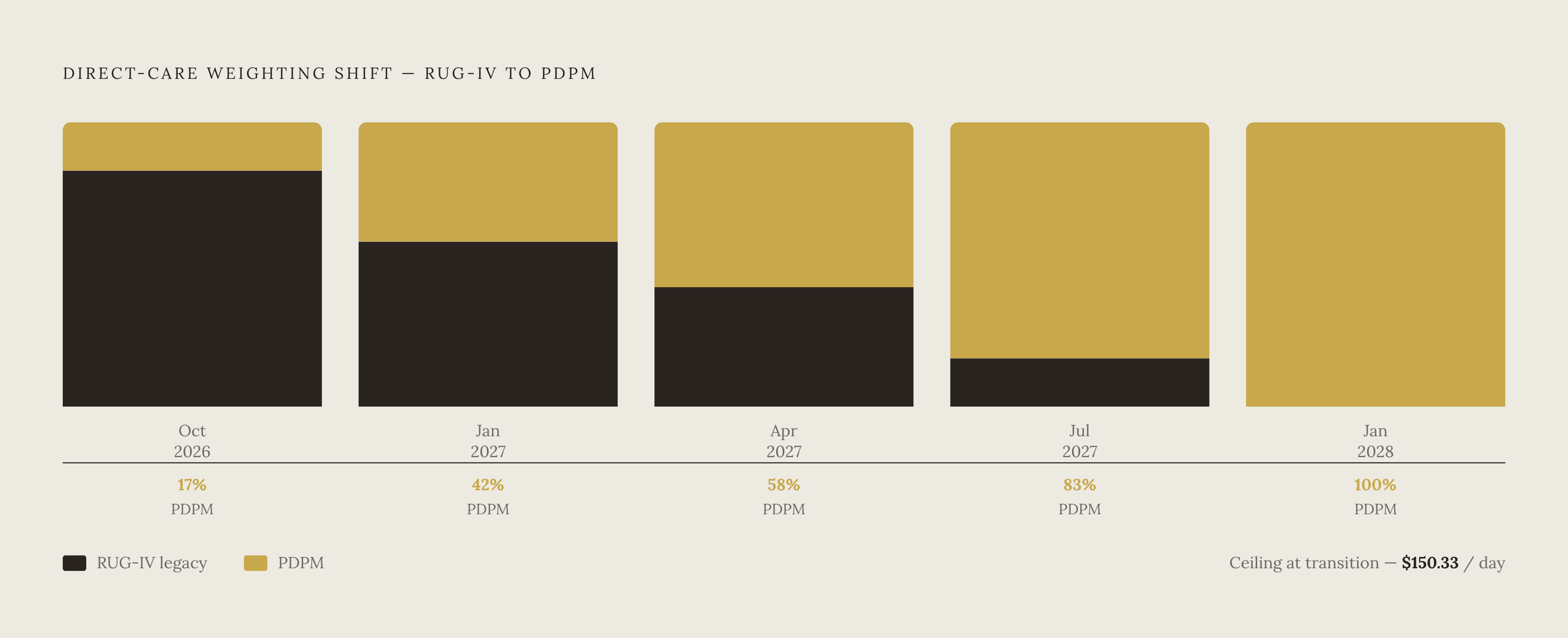
The same federal flexibility that permits states to choose their methodology produces five meaningfully different reimbursement regimes. Each requires a different operational and compliance response. North Carolina operates a phased PDPM blend on a cost-report foundation. The state's State Plan Amendment, SPA #2025-0026, submitted December 18, 2025, transitions the SNF program from RUG-IV to a PDPM rate structure with a proposed effective date of October 1, 2025. The transition is explicitly staged: the direct care component begins at 83% legacy and 17% PDPM on October 1, 2026, moving quarterly to 0% legacy and 100% PDPM by January 1, 2028. The statewide direct care ceiling as of the transition date was $150.33 per day, trended forward until costs are rebased. The cost-report foundation remains intact: rates derive from audited cost reports for a base year, with desk audits on all filings plus a minimum of fifty field audits selected on a risk basis, including providers whose direct or indirect cost per patient day sits above or below the Medicaid day-weighted median. An operator in North Carolina must track its legacy case-mix index and its PDPM nursing classification simultaneously during the transition, and cannot optimize for one at the expense of the other.
Connecticut uses only the PDPM nursing component, phased over three years. Effective July 1, 2026, the state calculates nursing-home case-mix index scores for quarterly case-mix adjustments to the direct-care component of the Medicaid per diem rate using the PDPM nursing component alone. Year three, SFY 2029, carries no such provisions. Only the nursing component drives Medicaid acuity adjustment there.
Texas implemented its patient-driven payment model for long-term care, PDPM LTC, effective September 1, 2025 under Texas Administrative Code rule §355.318. The Texas Health and Human Services Commission rate table documentation notes that many MCO contracts pay providers a percentage of the FFS rate, and the minimum reimbursement rate paid to a nursing facility in managed care is currently equivalent to the FFS nursing facility reimbursement rate. A Texas SNF with significant managed-care volume cannot treat the PDPM-LTC rate as irrelevant to managed-care contracting. It is the floor and the reference point.
California remains cost-based, facility-specific, with no PDPM framework. The Department of Health Care Services updates Medi-Cal reimbursement rates for freestanding SNFs each calendar year using a cost-based facility-specific methodology pursuant to Supplement 4 of Attachment 4.19-D of the California Medicaid State Plan. The CY 2027 rate study public review drafts were published, with DHCS requesting comments no later than October 16, 2026, pending approval of SPA 26-0010. MDS acuity classification plays no direct role, and the WSP participation decision has a direct per-diem consequence.
Maryland is price-based, prospective, and organized around four cost centers: administrative and routine, other patient care, capital, and nursing services including certain direct care costs such as therapies. The state enacted a one-time three percent rate increase through the state budget bill effective July 1, 2025. Rate adequacy depends on how aggressively the state updates its benchmarks. The four cases together make the point: the same federal permission produces genuinely different operational requirements.
The rate-adequacy problem hiding inside methodological diversity
Methodology choice is not neutral. States that use chronically lagged cost bases or price benchmarks that trail actual costs effectively shift financial risk onto facilities, and in markets with low Medicare occupancy the cross-subsidy that masks that risk breaks down. This is where the financial consequence of methodological diversity becomes material.
Ohio's proposed rate increase, the largest single-year increase in over a decade, was driven by the state's facility closure rate since 2019. The structural tension underneath this is long-standing. Medicare's higher payment levels allow states to keep Medicaid rates below cost under the assumption that cross-subsidy exists. There is no Medicare volume surplus to cover the Medicaid shortfall.
A second tension runs through the policy debate. Connecticut's nursing-component-only approach reflects a deliberate policy judgment that full PDPM does not fit long-term Medicaid populations. Where the answer is no, the facility is financing state policy through its own balance sheet.
Why cost report accuracy is the foundation that all rate methodologies sit on
Whatever methodology a state uses, the cost report is the document that anchors rate-setting, audit exposure, and lender confidence. Errors in it carry consequences across all three. Outlier cost positions increase audit probability. But the cost report is not only a cost-state concern.
The CMS-2540-24 cost report form, effective for cost reporting periods ending on or after September 30, 2025, means facilities are now filing on a new form that supports Medicare reimbursement settlement, rate-setting, and federal policy analysis. A facility with a September 30 fiscal year-end used the new form for periods ending September 30, 2025. A calendar-year facility uses it for the period ending December 31, 2025. The form change is already in effect, not pending.
Related-party cost reporting is an identified and persistent audit gap. Massachusetts adds a statutory filing layer: all 2025 nursing facility cost reports are due by June 1, 2026, and under regulation 957 CMR 7.00, effective February 27, 2026, any nursing facility, realty company, management company, or parent organization that obtains independent audited financial statements must file a complete copy. The common thread is that the facility's own financial reporting is the substrate beneath every methodology. Its quality determines both the rate received and the audit risk carried.
The MDS workflow risk that state methodology differences create for multi-state operators
The most common and costly operational error for multi-state SNF operators is managing Medicaid case-mix from a Medicare PDPM assumption. Staff spend significant time reviewing Medicare-relevant MDS components, therapy minutes and NTA conditions among them, that do not affect the Medicaid rate in a nursing-component-only state like Connecticut. The effort is real, and it is pointed in the wrong direction.
The inverse error also exists. Cost-control and WSP participation decisions drive the facility-specific rate instead. Time spent on MDS acuity review in California is time not spent on the cost report or the WSP filing.
For states mid-transition, the workflow problem compounds. In North Carolina through January 2028, the correct workflow must account for two simultaneous case-mix frameworks, the legacy RUG-IV-derived direct care rate and the emerging PDPM direct care component, with the weighting shifting quarterly. The map should identify, for each state, which methodology applies, which assessment items affect Medicaid payment, which assessment schedule applies, and which case-mix components are used. In states with significant Medicaid managed-care penetration, the negotiated contract rate may diverge from the state fee-for-service rate, and the FFS rate becomes a reference floor rather than the operative payment. The payment map must account for that divergence as well.
What SNF operators and their advisors should do given this landscape
The appropriate response to this landscape is not a single operational fix but a structured, state-specific review that connects rate methodology to cost reporting, MDS workflow, and audit readiness simultaneously. The starting point is the payment map: a maintained, state-by-state record identifying the methodology family, the specific case-mix tool if any, the assessment items that affect Medicaid payment, the rate update cycle, and any active transition or phase-in schedule. That map is the control document for everything else.
The cost report deserves treatment as a strategic document, not merely a compliance filing. In cost-based states it directly determines rates. Related-party cost disclosures and allowable-cost classifications warrant specific review given the OIG's December 2024 finding that most SNFs audited in its sample had related-party cost reporting errors.
MDS review workflows should align to state Medicaid methodology, not to Medicare PDPM. In nursing-component-only states, concentrate Medicaid-relevant review on nursing classification. The revenue gain and the compliance obligation arrive together, and both require documentation and internal controls.
The intersection of state Medicaid rate methodology, federal cost reporting requirements, HUD Section 232 obligations where applicable, and MDS accuracy is genuinely complex and actively changing. Financial statement audits that surface cost-report weaknesses before the state or MAC does, and SOC examinations for third-party billing or clinical systems embedded in Medicaid managed-care contracting, matter more now for a complete assurance picture for SNF operators. The landscape rewards those who treat it as a set of distinct state-level obligations rather than a single national rule.