PDPM Component Scoring and Revenue Optimization
Five assessment components drive SNF payment; each fails independently.

A skilled nursing facility’s daily Medicare rate depends on five separate classifications made early in the stay. Defensible revenue integrity therefore starts with capturing the resident’s clinical needs accurately, then understanding how those classifications translate into payment over time.
Why a SNF's daily rate is an assembly problem, not a billing problem
An administrator reporting a single average Medicare Part A per diem is reporting an arithmetic result. Under PDPM, five independent case-mix components are assembled from a single MDS assessment completed in the first eight days of the stay. Those classification decisions produce the five-character HIPPS code on the UB-04. Billing submits that code but does not create the clinical findings behind it. By Triple Check, the assessment may already have set payment for the entire benefit period.
Under RUG-IV, therapy minutes delivered after admission could change the payment. Under PDPM, accurate clinical capture during the assessment window is the central discipline. Yet the document that prices up to one hundred consecutive days is completed by clinicians under time pressure and rarely audited against the chart it summarizes. Management should therefore check whether the assessment faithfully represents the resident, rather than whether billing transmitted its output correctly.
How the five components are classified and what each one actually measures
PT classification draws on the primary diagnosis in MDS item I0020B, mapped to one of ten PDPM clinical categories, and the admission Section GG functional score. These drivers assign the resident to one of sixteen groups, without reference to therapy minutes. OT uses the same clinical category and functional score but is classified separately. A resident therefore receives both a PT group and an OT group, which can differ.
SLP classification measures a different set of needs. Its twelve groups depend on the acute neurologic clinical category, defined SLP comorbidities, cognitive impairment in Section C, and swallowing disorder and mechanically altered diet information in Section K. Nursing has the widest classification range, with twenty-five groups. Its drivers include extensive services such as IV medications and ventilator use, clinical conditions, the depression indicator, restorative nursing programs, and the function score.
NTA classification depends entirely on a comorbidity point score. CMS found fifty conditions linked to higher NTA resource costs and gave each a point value based on how much it added to those costs. The total determines one of six case-mix groups. Nursing and NTA together account for the majority of the daily rate. A sixth, non-case-mix component adds a flat amount regardless of clinical characteristics, leaving five rows that respond to assessment content and one that does not.
Where each component consistently loses revenue and why the failures are independent
PT documentation breaks down when Section GG reflects one observation shift rather than usual performance across the full observation window. A lower GG score reflects greater dependence, but defaulting to maximum dependence without clinical support creates audit risk. Rushing toward minimum dependence to speed intake can instead lose revenue. OT inherits the same defect because it shares PT’s functional score and primary diagnosis clinical category. Although the components are separately classified, a single input error can move both.
SLP has a different failure point at the transfer from chart to assessment. The clinical record may have swallowing disorder documentation and mechanically altered diet orders that never reach Section K. Nursing loses capture when the MDS items for extensive services, complex infections, or isolation precautions leave out what was ordered and clinically present. NTA loses capture when comorbidities in the hospital discharge summary are not coded in Section I. A missed high-point condition can lower the NTA group and reduce payment throughout the stay.
These failures are independent in the practical sense that strong documentation in one area does not establish completeness elsewhere. A facility can record function carefully while missing comorbidities that the hospital documented. Because Nursing and NTA account for most of the rate, those omissions can outweigh apparent strength in therapy classification. Decomposing the per diem into its six rows reveals where a component is underperforming. An average alone conceals the location of the gap.
How the variable per diem schedule changes the rate across the benefit period
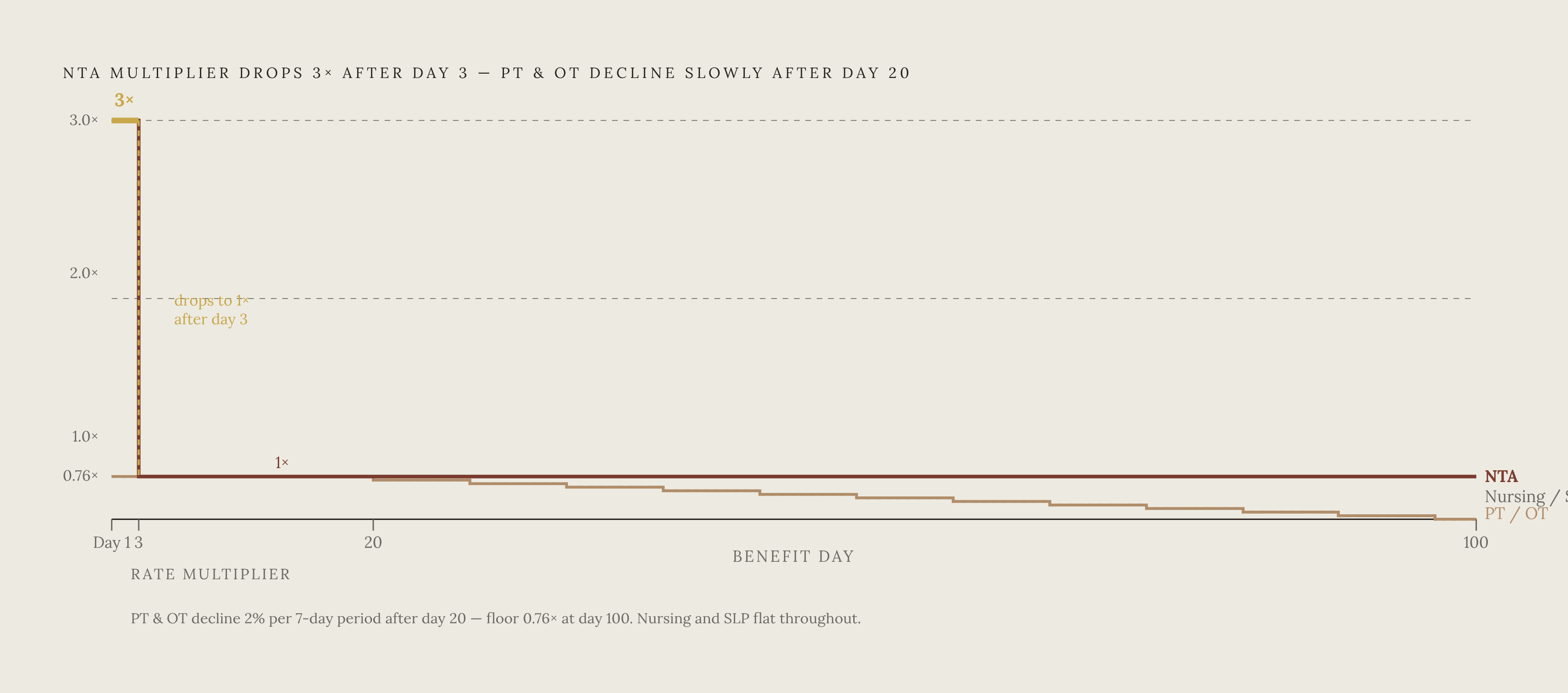
Classification is only one dimension of payment because three components also change with time. CMS’s variable per diem schedule applies a factor of 3× to NTA on days one through three, then 1× from day four onward. PT and OT begin at a factor of 1.00, with reductions starting after day twenty. They decline in two-percent increments every seven days through day one hundred, reaching 0.76. Nursing and SLP stay the same throughout the stay.
For a high-NTA resident, the first three days therefore include three times the classified NTA component, while day thirty includes its base value and reduced PT and OT components. The HIPPS code can be identical even though the total daily payment differs. Missing an NTA condition has three times the component-level financial impact during those first three days that it has later.
The schedule also changes how financial variance should be read. A forecast that ignores PT and OT reductions can overstate revenue on long stays and understate it on short ones. A shift in length of stay may then look like a coding problem when it is simply the published payment schedule. The assessment reference date is a documentation control point within this timing structure.
What the FY2026 ICD-10 mapping changes mean for classification accuracy
CMS’s FY2026 SNF PPS final rule, CMS-1827-F, published August 4, 2025 at 90 FR 37310, took effect October 1, 2025. It finalized thirty-four technical revisions to PDPM ICD-10 mappings. These included thirty-three codes moved from Medical Management to Return to Provider, including codes for Type 1 diabetes, hypoglycemia, and obesity. This was a change in classification eligibility, not simply a different payment weight.
A Return to Provider code used as the primary diagnosis in I0020B prevents assignment to a PT or OT group until the diagnosis is corrected. A familiar diagnosis can therefore become unusable for that purpose through a rule change even when staff follow their established workflow. The RAI Manual v1.20.1 also changed the documentation framework effective October 1, 2025, removing O0420, Distinct Calendar Days of Therapy, and introducing O0390, Therapy Services.
Accuracy consequently requires an annual update discipline. MDS coordinators and physicians must compare frequently used primary diagnoses with the current CMS PDPM ICD-10 Mapping file before setting the assessment reference date for new admissions. A mismatch between the coded diagnosis and current mapping also creates a visible pathway to an F641, Accuracy of Assessments, citation.
What the OIG's first PDPM series audit reveals about enforcement trajectory
The OIG’s November 2025 Report A-02-22-01017 examined Pinnacle Multicare Nursing and Rehabilitation Center in the Bronx. It found noncompliance with Medicare requirements in ninety-nine of one hundred sampled PDPM claims and estimated overpayments of at least $31,227,884. The OIG described the review as “the first in a series of audits of SNFs that billed for skilled nursing services under PDPM,” making its significance broader than one provider. Pinnacle’s attorney disputed the findings, characterizing the alleged errors as immaterial and challenging the interpretation of coding requirements.
CMS separately announced that, beginning January 2026, approximately one in ten SNFs would be selected for structured data validation reviews. Each selected facility would submit medical records supporting up to ten MDS assessments for comparison with submitted data. The two review tracks deal with related but different risks: recovery of overpayments on claims and the accuracy of data in assessments. Their shared test is whether chart evidence supports the coded conditions and scored items. A workflow that cannot trace assessment entries to source documents carries exposure regardless of intent, even if its other gaps also suppress legitimate revenue.
How a documentation workflow built around the five-day assessment window closes the gap
The workflow begins by working backward from the assessment reference date. Every clinical source feeding a case-mix component must be reviewed, translated into MDS items, and supported by chart evidence before the window closes. The MDS coordinator reviews the NTA comorbidity list against the hospital discharge summary before admission. RNs document extensive services in formats that map to Nursing items. SLP or nursing staff make sure that swallowing disorder and altered diet texture orders appear in Section K.
Section GG requires a shared observation discipline across CNAs and therapists. Staff need the same understanding of the observation window and each functional rating. The FY2026 RAI Manual reiterates the longstanding Dependent definition requiring two or more helpers. Consistent use of that definition across shifts helps PT and OT reflect the resident’s function.
Tools can assist this translation without replacing its evidentiary standard. AI-assisted natural language processing can scan physician notes, nursing narratives, pharmacy logs, and lab results to flag details that might be coded before the assessment reference date closes. When the resident’s condition changes materially afterward, an Interim Payment Assessment can replace the original HIPPS code prospectively. It is not a routine catch-up tool for missed initial coding, and it does not recover front-loaded days already billed.
How the capital structure around SNF operators amplifies the cost of documentation gaps
A small daily gap in documentation can add up to a large variance in the financial statements over a year of Medicare-covered days. MedPAC’s March 2025 report to Congress documents that FFS Medicare represents a relatively small share of most nursing homes’ business, making its margin disproportionately important to overall performance. The report also shows substantially thinner Medicare margins at the smallest facilities than the sector average. Twenty states have adopted PDPM’s Nursing component for Medicaid payment, so a systematic Nursing coding gap can affect two payers.
HUD OIG Report 2026-BO-0001, dated April 2, 2026, found that nearly five percent of HUD-insured Section 232 borrowers had defaulted as of June 2024. It also found that HUD’s Office of Residential Care Facilities had not promptly mitigated reported financial risks, including unauthorized surplus cash distributions, cash deficiencies, and insufficient debt-service cash flow. The finding shows why recurring revenue shortfalls matter within a capital structure monitored through audited financial statements.
The HUD Section 232 framework requires a financial statement audit and a compliance audit of major HUD programs under GAAS and GAGAS. Revenue backed by documentation goes into the financial figures and covenant ratios that those audits review. A sustained pattern of undercoding therefore raises questions about both cash flow and the adequacy of internal controls.
What defensible revenue integrity requires from the assurance and advisory function
Even when a facility’s own workflow is accurate, someone outside it still needs to test the results. Staff who review assessments they completed may miss patterns that recur in their own work. The financial statement audit tests revenue completeness and the controls that produce it. A probing audit can surface systematic component undercoding and assessment-to-chart discrepancies. For HUD-financed operators, that work requires knowledge of both PDPM mechanics and the HUD covenant framework.
Vendor assurance also depends on the operator’s own controls. Operators relying on EHR and billing platforms that process financial data should verify current SOC 1 reports issued under SSAE 18. The reports need to cover the relevant services and period, as well as identify the complementary user entity controls the operator must implement. Possessing a report is not a substitute for carrying out those controls.
The advisory relationship must extend beyond audit season as well. For closely held SNF operators, pass-through entity taxation, real-property cost segregation, and annual tax planning interact with Medicare revenue variability. To give useful advice, an advisor needs results for each component, controls over the assessment window, checks of the current mapping, and variable per diem modeling. An advisor who receives only an average per diem at year-end cannot judge whether the revenue behind it has support. Defensible revenue integrity joins disciplined clinical documentation with an advisor who understands how that documentation becomes the rate.